
The Best AI Tools for Content, Email, Video, and Operations (And How to Use Them Together)
There’s a common misconception happening right now in business.
That “using AI” means using one tool.
Usually, that tool is ChatGPT.
And while tools like OpenAI are incredibly powerful, relying on a single platform is like trying to run a company with only one employee.
It works… until it doesn’t.
Because modern businesses are not scaling with a single tool.
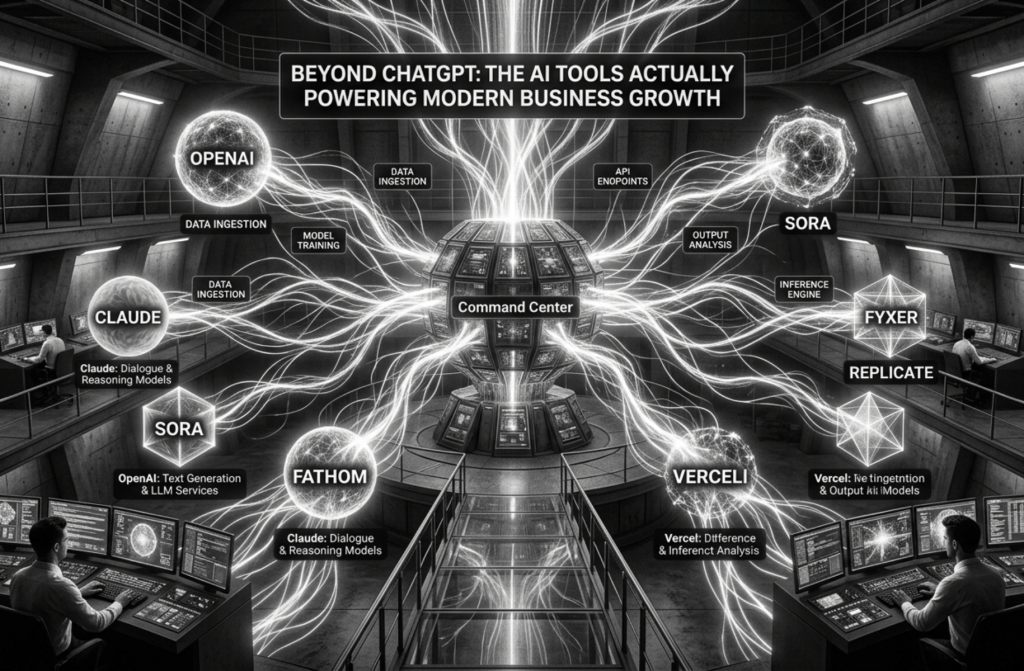
They are scaling with systems of tools.
An ecosystem.
An AI army.
Each tool plays a different role.
Each one solves a different bottleneck.
And when they’re connected properly, they create leverage that compounds.
This is how smaller teams are operating faster, producing more, and scaling without adding overhead.
Because modern growth doesn’t come from isolated tools. It comes from connected systems, or what we call ecosystem marketing.
Below is the stack we actually use, and more importantly, how each tool fits into a real workflow inside a real business.
The Shift: From AI Tool → AI System
Before we break down the tools, let’s zoom out for a second.
AI is not about replacing tasks.
It’s about restructuring how work flows through your business.
Instead of:
Manual input → Manual output
It becomes:
Idea → AI-assisted execution → Automated distribution → Ongoing optimization
And without that structure, most businesses end up exactly where they started, busy, but not scalable.
Which is why clarity before scaling matters more than tools themselves
Because tools don’t fix chaos.
They amplify it.
But when the strategy, execution, and tools are optimized, they eliminate friction across your entire operation.
1. OpenAI: The Core Engine Behind Modern Content and Automation
OpenAI is where most people start and for good reason.
But most businesses are using it like a calculator when it can actually function more like an operating system for thinking, writing, and responding.
At its highest level, OpenAI becomes the place where your brand voice, your offers, and your ideas are consistently translated into valuable output.
The more context you give, the better content you get because without context, even great content falls flat. —which is exactly why most entrepreneurs struggle with consistency
It’s not just about generating content.
It’s about codifying how your business communicates.
When done correctly, this type of output becomes content that compounds over time rather than one-off posts that disappear.
What OpenAI is best for:
- Custom GPT avatars (brand voice, content assistants, SOP assistants)
- Content creation at scale
- Conversational AI inside platforms like GoHighLevel (GHL)
Real OpenAI workflow:
- Train a custom GPT on your brand voice, offers, and audience
- Use it to generate:
- Blog drafts
- Email sequences
- Social content
- Blog drafts
- Connect it to GHL to power:
- Lead responses
- SMS/email follow-ups
- Lead responses

Instead of writing everything manually, you’re directing output instead of producing it from scratch.
2. Claude: Turning Chaos Into Structured Systems
Where OpenAI excels at output, Claude excels at structure.
This is the tool we lean on when things feel messy.
Ideas that aren’t organized.
Processes that only exist in your head.
Operations that break when handed to someone else.
Claude is incredibly strong at taking unstructured information and turning it into clear, logical systems.
This is especially powerful when building the kind of backend that supports scale. This is what we define as true marketing infrastructure.
What Claude is best for:
- SOP creation
- Internal documentation
- Process mapping
- Strategic thinking and breakdowns
Real Claude workflow:
- Take a messy process (onboarding, fulfillment, content production)
- Drop it into Claude
- Have it:
- Turn it into a step-by-step SOP
- Identify gaps or inefficiencies
- Suggest improvements
- Turn it into a step-by-step SOP
This is one of the fastest ways to move from “I do everything” to “this runs smoothly without me.”
3. Vercel: Removing the Bottleneck Between Idea and Launch
One of the biggest hidden growth killers in small businesses is delay.
Ideas sit.
Web pages don’t get built.
Landing pages take weeks instead of hours.
Vercel solves a very specific problem:
Speed to execution for websites.
It allows you to go from idea → live page without getting stuck in development cycles.
What Vercel is best for:
- Rapid landing page deployment
- Clean, fast, high-performance pages
- Testing offers quickly
Real Vercel workflow:
- Use OpenAI to generate landing page copy
- Deploy quickly using Vercel
- Launch in hours instead of weeks
- Test messaging and offers without overthinking
This shifts your business from “planning mode” to execution mode.
4. Sora: Scaling Video Without Scaling Production
Video is no longer optional.
But for most business owners, it’s one of the hardest things to produce consistently.
Filming. Editing. Lighting.
Time.
Sora changes that by allowing you to generate video content without needing a traditional production workflow.
It removes the friction between idea and visual execution.
And when paired with strong ideas, it helps amplify your authority stack allowing you to increase visibility across multiple formats.
What Sora is best for:
- AI-generated video content
- Visual storytelling
- High-volume short-form content
Real Sora workflow:
- Take a blog or idea
- Turn it into a script using OpenAI
- Generate visuals with Sora
- Publish across:
- Reels
- TikTok
- Shorts
- Reels
This allows you to produce consistent video content without becoming a full-time creator.
5. Fathom: Turning Conversations Into Content and Insight
Most business owners underestimate how valuable their conversations are.
Sales calls.
Client calls.
Strategy sessions.
Inside those conversations are:
- objections
- language
- insights
- patterns
Fathom captures all of it automatically.
And more importantly, it feeds directly into what we call the invisible sales engine where trust is built long before a sales conversation ever happens.
What Fathom best for:
- AI note-taking in meetings
- Call summaries
- Action item tracking
Real Fathom workflow:
- Record calls with Fathom
- Use summaries to:
- Send follow-ups
- Extract content ideas
- Identify recurring problems
- Send follow-ups
One conversation can become:
- A blog
- Multiple social posts
- Email content
- Project status updates

This turns your day-to-day work into content and strategy fuel.
6. Fyxer: Reclaiming Your Time From Email
Email doesn’t look like a major problem until you track how much time it consumes.
Responding. Sorting. Following up.
It fragments your day and spreads your focus.
Fyxer acts like a layer between you and your inbox.
Not just organizing it, but actively helping you move through it faster.
What Fyxer is best for:
- AI email drafting
- Inbox organization
- Prioritization
Real Fyxer workflow:
- Fyxer drafts replies in your tone
- Organizes conversations by urgency
- Reduces time spent in inbox dramatically
Instead of reacting all day, you quickly process and move on.
7. Replicate: Visual Content Without Creative Bottlenecks
Visual content is one of the biggest leverage points in marketing.
But it often depends on designers, timelines, and revisions.
Replicate gives you the ability to generate custom visuals on demand.
Which means your ideas don’t have to wait for a design team.
And in a world flooded with AI-generated content, the real advantage is not volume, it’s signal vs noise.
What Replicate is best for:
- AI image generation
- Creative experimentation
- Visual assets for marketing
Real Replicate workflow:
- Generate images for:
- Blog headers
- Social content
- Ads
- Blog headers
- Test multiple creative directions quickly
- Pair with written content from OpenAI
This speeds up content production while increasing creative flexibility.
How It All Connects (The Real Advantage)
Individually, these tools are useful.
Together, they become a system.
Here’s what that system looks like in action:
- Fathom captures a call
- OpenAI turns insights into content
- Claude structures it into and SOP or project update
- Replicate creates visuals
- Sora turns it into video
- Vercel hosts the landing page
- Fyxer manages follow-up communication
One input → multiple outputs → ongoing distribution
When these systems are connected properly, they begin reinforcing each other and create an effect similar to the trust flywheel.
That’s not productivity.
That’s leverage.
Why Using One Tool Holds You Back
The biggest mistake right now is thinking:
“I just need to learn AI.”
No.
You need to design how AI fits into your business system.
Because one tool creates output.
But a connected system creates momentum.
And momentum is what allows small teams to scale like large ones.
It also aligns with a larger shift happening in marketing:
Attention is no longer something you can force, it has to be earned.
What This Can Actually Mean for Your Business
AI is not a shortcut.
It’s an amplifier.
It amplifies:
- your ideas
- your systems
- your efficiency
But only if it’s structured correctly.
The businesses winning right now are not asking:
“What can this tool do?”
They’re asking:
“How do these tools work together to remove friction from my business?”
And ultimately, this is how businesses evolve into something more durable.
Not just fast-growing.
But legacy brands that outlast algorithms.
If You’re Ready to Build Your AI Infrastructure
Most businesses do not struggle because they lack marketing tools.
They struggle because their growth systems were never designed to build trust and authority at scale.
At Legacy Growth, we don’t sell hacks. We build durable growth infrastructure.
If you want your time back, your energy back, and your growth back, let’s talk.

➡️ Book a strategy call with LegacyGrowth.life
We’ll audit your current work structure, show you exactly what to delegate, and help you build a VA system that compounds.
No gimmicks. Just execution that actually works.


 Legacy Growth Blog
Leave a comment