

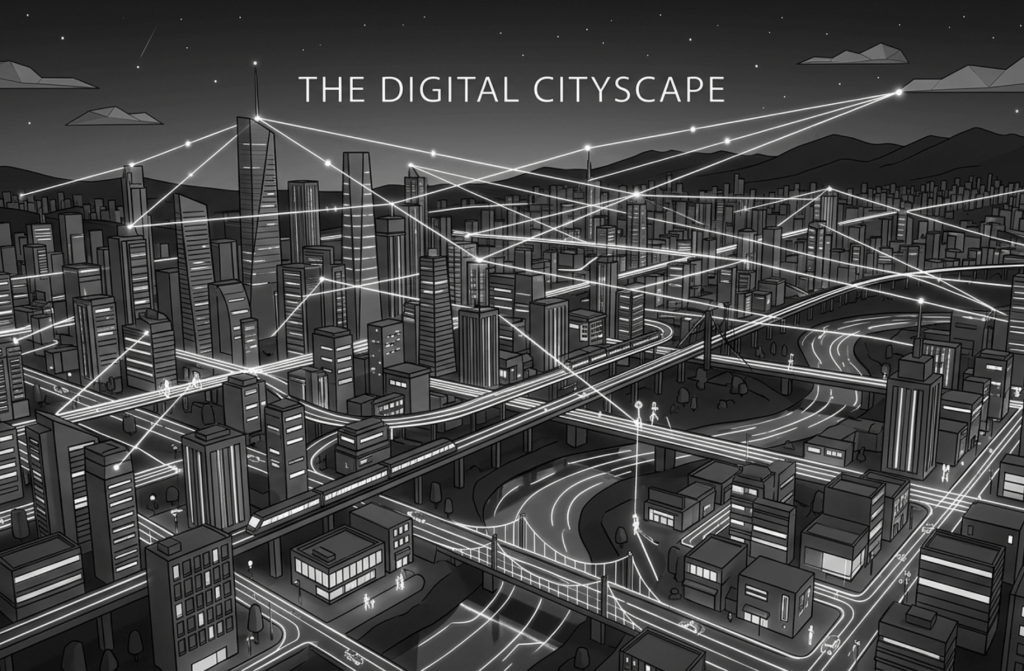
Imagine walking into a well-designed city.
Everything connects.
The streets lead somewhere useful.
The signs help you navigate.
The public spaces encourage people to stay.
Nothing feels random. Each piece was designed with the rest of the environment in mind.
Now imagine the opposite.
A collection of buildings scattered with no roads connecting them. No clear direction. No structure.
You might find something useful eventually, but the experience feels confusing and disjointed.
Many businesses unknowingly build their marketing the second way.
A social media strategy here.
An email campaign there.
A funnel launched during a promotion.
Each effort may work individually, but none of them are truly connected.
Ecosystem marketing takes a completely different approach.
Instead of isolated tactics, it designs an environment where every piece reinforces the others.
The Customer Journey Is No Longer Linear
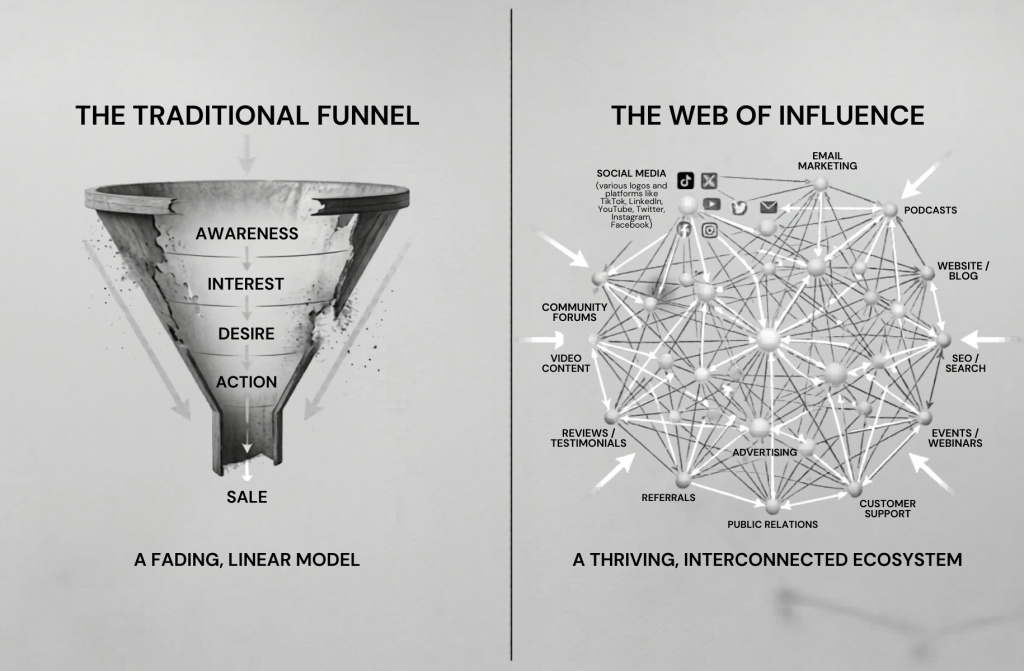
For years, marketing strategies assumed buyers moved through a predictable funnel.
Discover the brand.
Learn about the product.
Make a purchase.
But modern buying behavior rarely follows that sequence.
A potential customer might first encounter a brand through an article.
Weeks later they might see a short video explaining the same topic.
Months later they hear the founder interviewed on a podcast.
Only after several of these interactions do they visit the website.
And even then, they may not purchase immediately.
Instead, they join the newsletter.
Read a few emails.
Watch a webinar.
Then finally decide to work with the company.
This journey doesn’t resemble a straight line.
It resembles a network.
The Power of Interconnected Touchpoints
Ecosystem marketing recognizes that people interact with brands across many environments.
Content platforms.
Email communication.
Social conversations.
Educational events.
Community spaces.
Each touchpoint offers an opportunity to strengthen the relationship.
But the real power appears when those touchpoints work together.
An article introduces an idea.
An email expands on that idea.
A video explains how the idea works in practice.
A webinar demonstrates it with real examples.
Instead of repeating the same message, the ecosystem deepens understanding over time.
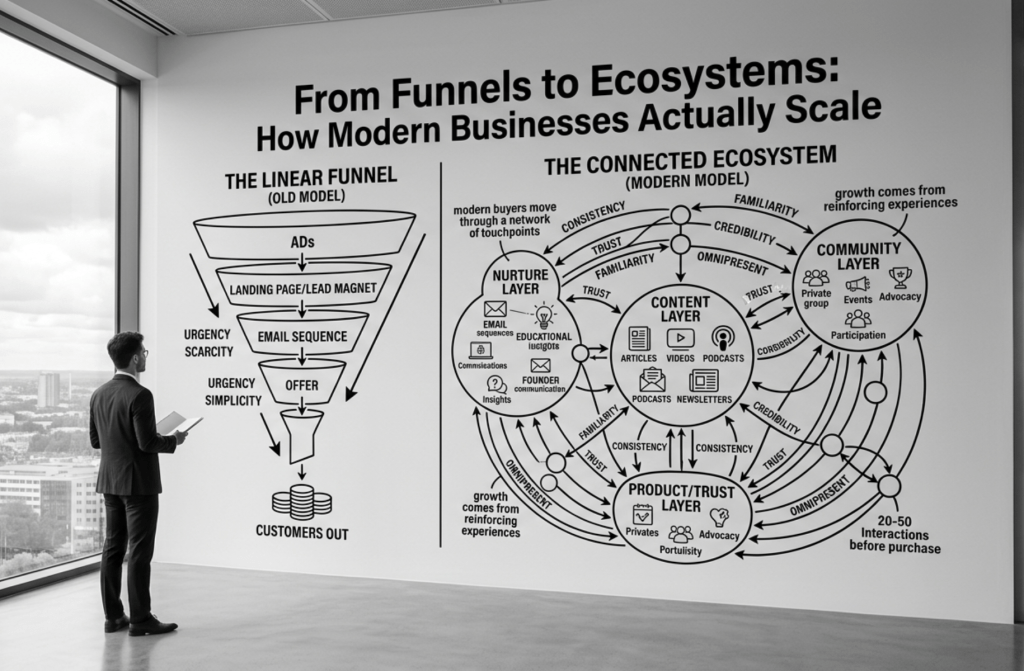
The Content Layer
At the foundation of most marketing ecosystems is content.
Content acts as the entry point for new relationships.
Articles help people discover new perspectives.
Videos explain concepts visually.
Podcasts allow audiences to hear conversations in real time.
These formats introduce the brand’s thinking to new audiences.
And because content can be discovered long after it was created, it continues attracting attention long into the future.
This is where the compounding effect begins.
The Automation Layer

Once someone enters the ecosystem, automation helps guide the relationship forward.
Automation does not replace human interaction.
Instead, it ensures consistency.
A new subscriber might receive a series of thoughtful emails introducing the brand’s philosophy.
Someone who attends a webinar might receive follow-up resources to explore the topic further.
Prospects who show interest in a particular topic might receive content tailored to that interest.
These systems make sure that each person’s journey continues naturally, even as the business grows.
The Nurture Layer
Most people do not buy immediately.
They need time to observe the brand.
Time to learn.
Time to develop confidence.
Nurture systems support this process.
Through newsletters, educational insights, and ongoing communication, the brand remains present without applying pressure.
The goal is not to accelerate the decision.
It is to help the audience become more informed and comfortable over time.
When nurture systems are working well, the eventual purchase feels like a natural progression.
When the Pieces Begin Reinforcing Each Other
The real strength of ecosystem marketing appears when these layers begin interacting.
Content attracts attention.
Automation organizes the experience.
Nurture strengthens the relationship.
Each component feeds the others.
A reader becomes a subscriber.
A subscriber becomes a participant in a webinar.
A webinar attendee becomes a client.
A client shares their experience with others.
The system begins generating its own momentum.
Why Ecosystems Scale More Naturally
When marketing efforts remain disconnected, growth requires constant effort.
Every campaign starts from scratch.
Every new lead requires manual attention.
Ecosystems behave differently.
Once the structure exists, each new person entering the system benefits from everything that has already been created.
Content written months ago still attracts readers.
Email sequences written once continue educating new subscribers.
Recorded webinars continue introducing new audiences to the brand’s thinking.
The system grows stronger as it expands.
Designing the Environment
Ecosystem marketing is not about adding more channels.
It is about designing the experience intentionally.
Every touchpoint should answer a simple question:
How does this help the audience move one step closer to understanding and trusting the brand?
When that question guides every piece of communication, the marketing environment begins to feel coherent.
Instead of isolated campaigns, the audience experiences a connected journey.
The Compounding Effect of a Well-Built Ecosystem
The beauty of a well-designed ecosystem is that it grows stronger over time.
New content expands the library of ideas.
New subscribers enter the nurture process.
New clients contribute testimonials and insights.
Each addition strengthens the system that already exists.
Eventually, the brand stops relying on constant marketing pushes.
The ecosystem itself becomes the engine of growth.

Final Thought
Marketing is often treated as a series of tactics.
Post this.
Launch that.
Run another campaign.
But the businesses that scale predictably approach it differently.
They design an environment where every interaction strengthens the next one.
Content introduces the brand.
Automation organizes the journey.
Nurture deepens the relationship.
Together, these elements create a loop that reinforces itself.
And over time, that loop transforms marketing from a set of activities into a system that compounds.
Book Your Discovery Call
Most businesses do not struggle because they lack marketing tools.
They struggle because their growth systems were never designed to build trust and authority at scale.
At Legacy Growth, we don’t sell hacks. We build durable growth infrastructure.
If you want your time back, your energy back, and your growth back, let’s talk.
➡️ Book a strategy call with Legacy Growth
We’ll audit your current work structure, show you exactly what to delegate, and help you build a VA system that compounds.
No gimmicks. Just execution that actually works.


 Legacy Growth Blog
Leave a comment