
From the outside, growth often looks simple.
A brand appears everywhere.
Leads come in consistently.
Sales conversations happen daily.
To someone looking in, it can seem effortless.
Maybe the company has great ads.
Maybe their content performs well.
Maybe they just “figured out marketing.”
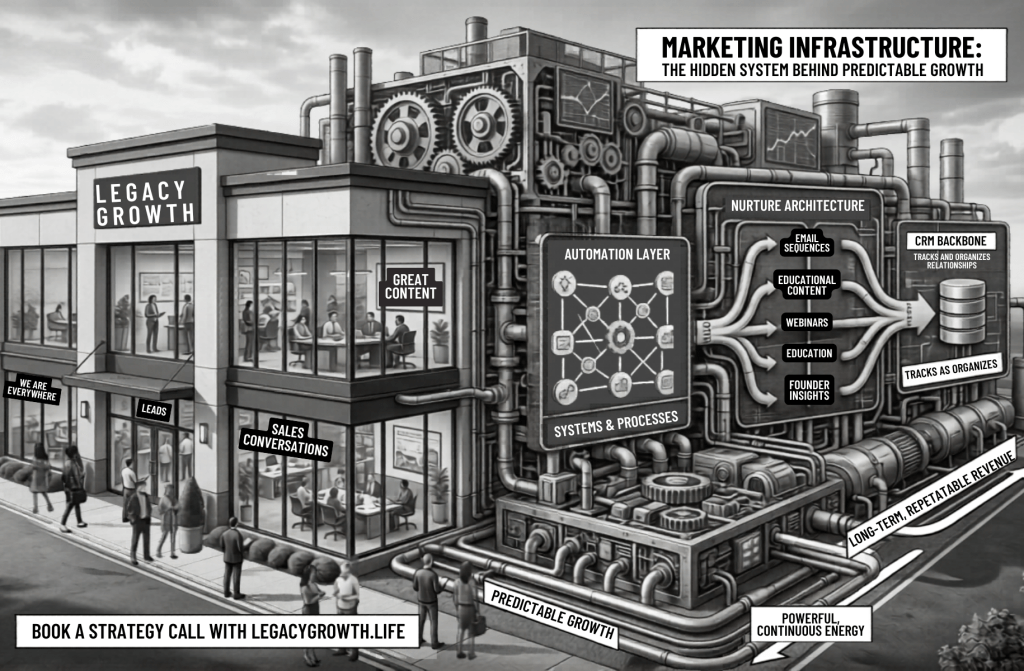
But when you look behind the scenes of businesses that grow predictably, you usually find something else entirely.
You find infrastructure.
The systems, processes, and operational architecture that quietly power everything the audience sees.
And without that infrastructure, growth rarely lasts.
The Problem With Campaign-Driven Marketing
Many companies treat marketing like a series of isolated campaigns.
A launch here.
An ad push there.
A content sprint when things feel slow.
Each campaign may create a temporary burst of attention.
But the momentum often fades just as quickly.
Leads slow down.
Engagement drops.
Revenue becomes unpredictable.
This cycle is exhausting for founders and marketing teams alike.
Because without a system supporting it, marketing requires constant manual effort.
Predictable growth doesn’t come from individual campaigns.
It comes from systems that run continuously in the background.
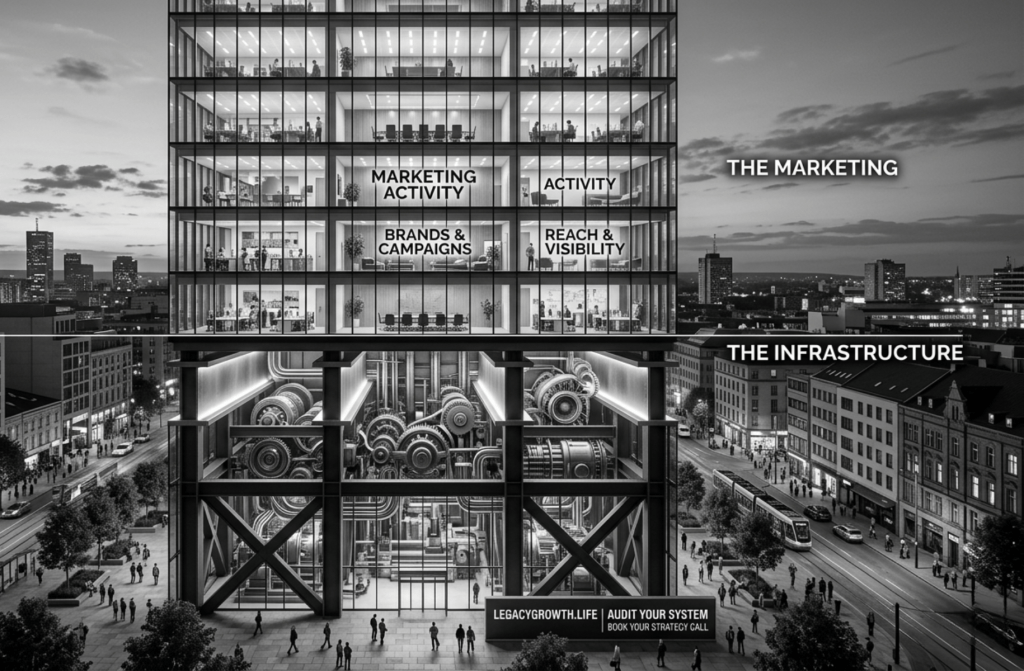
The Difference Between Marketing Activity and Marketing Infrastructure
Marketing activity is visible.
It’s the posts, ads, emails, and content that people encounter publicly.
Marketing infrastructure is what makes all of that activity possible.
It’s the architecture that connects the pieces together.
Without infrastructure, marketing feels chaotic.
With infrastructure, marketing becomes a coordinated engine.
Every action feeds into a larger system.
Content drives traffic.
Traffic enters nurture sequences.
Nurture builds trust.
Trust leads to sales conversations.
Each component supports the next.
The Automation Layer

Automation is often misunderstood.
Many people associate automation with impersonal messaging or robotic responses.
But when implemented well, automation does something far more valuable.
It creates consistency.
Every new lead receives the same thoughtful onboarding experience.
Every subscriber enters a structured educational journey.
Every prospect receives timely follow-ups without someone manually sending them.
Automation doesn’t replace human connection.
It ensures that no opportunity slips through the cracks.
And as businesses scale, that reliability becomes essential.
The Nurture Architecture
Not every potential customer is ready to buy immediately.
In fact, most aren’t.
They may be exploring options, learning about the problem, or simply observing the brand over time.
This is where nurture systems become critical.
Nurture architecture includes the educational and relationship-building experiences that help prospects move from curiosity to confidence.
This can include:
Email newsletters
Educational content sequences
Webinars or workshops
Retargeting content
Founder insights
The goal isn’t constant promotion.
The goal is continued relevance.
When nurture systems are working properly, the brand remains present in the audience’s world without feeling intrusive.
The CRM Backbone
As businesses grow, relationships become more complex.
There are leads who have just discovered the brand.
Prospects who are evaluating solutions.
Customers who have already purchased.
Partners, collaborators, and long-term community members.
Managing these relationships without a structured system quickly becomes overwhelming.
This is where CRM strategy becomes essential.
A well-designed CRM allows a company to understand where every contact exists in the relationship journey.
It tracks interactions.
It organizes conversations.
It allows teams to communicate more intelligently.
Instead of guessing where someone stands, the business has a clear map of the customer journey.
Why Infrastructure Creates Predictability

Predictable growth is rarely the result of luck.
It is usually the result of systems working together.
When infrastructure is strong, marketing stops feeling reactive.
Leads enter the system automatically.
Content continues attracting new audiences.
Nurture sequences educate prospects over time.
Sales teams engage with people who already understand the brand.
Instead of starting from scratch every month, the business operates from momentum.
And momentum is what allows growth to compound.
The Quiet Advantage
Most customers will never see a company’s marketing infrastructure.
They will see the results.
The helpful content.
The consistent communication.
The thoughtful follow-ups.
What they won’t see are the systems connecting all of those experiences behind the scenes.
But that invisible structure is often the difference between companies that scale and companies that struggle.
Because when infrastructure is strong, marketing stops depending on constant effort.
The system begins working with you instead of against you.
Final Thought
Marketing often gets credit for creativity.
For clever messaging.
For bold campaigns.
But the businesses that grow predictably understand something deeper.
Creativity attracts attention.
Infrastructure sustains growth.
When automation, nurture systems, and CRM architecture work together, marketing becomes far more than a collection of tactics.
It becomes an operational engine.
And that engine is what turns attention into long-term, repeatable revenue.

Book Your Discovery Call
Most businesses do not struggle because they lack marketing tools.
They struggle because their growth systems were never designed to build trust and authority at scale.
At Legacy Growth, we don’t sell hacks. We build durable growth infrastructure.
If you want your time back, your energy back, and your growth back, let’s talk.
➡️ Book a strategy call with LegacyGrowth.life
We’ll audit your current work structure, show you exactly what to delegate, and help you build a VA system that compounds.
No gimmicks. Just execution that actually works.

 Legacy Growth Blog
Leave a comment