


Most advisors have never calculated what it costs them to acquire a client, and there is a simple reason: for decades, it felt free. The referrals came, the practice grew, and no one had to run the math because there was no invoice attached to a good reputation. That works right up until you decide you want growth you can predict, and then the number you never calculated becomes the number that governs everything.
Why “free” referrals aren’t
Referrals feel free because the cost is not on a line item. But it is there. It is the years of relationship-building that produced the trust. It is the dependence on other people’s goodwill, which you cannot schedule. And it is the un-forecastability, the fact that you genuinely cannot tell your team, or a potential buyer of your firm, how many clients next quarter will bring. “Free but unpredictable and uncontrollable” is a real cost. It just does not show up until you try to grow on purpose.
The components of advisor CAC
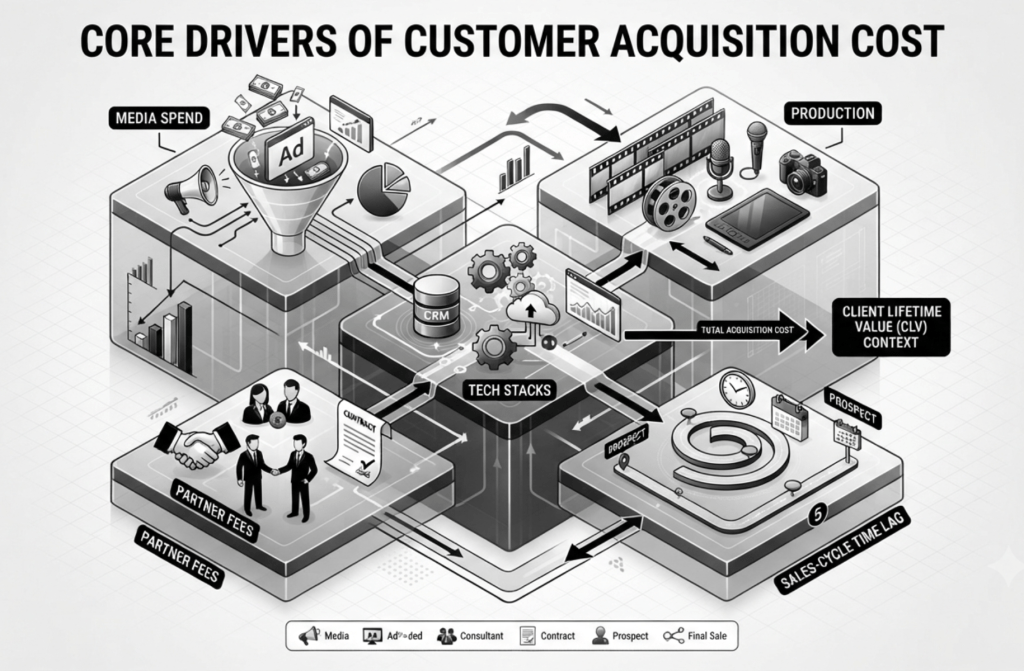
Once you are acquiring clients deliberately, the cost has knowable parts, and building the mental model matters more than any single number:
- Media spend, what you pay the platforms to reach people.
- Production, the cost of making the content and creative that spend runs on.
- Tools and systems, the CRM, the tracking, the infrastructure that catches and nurtures a lead.
- Partner or team cost, the agency fee or the internal salaries doing the work.
- Time to close, advisory sales cycles are long, and money spent today may not become a client for months. That lag is part of the cost.
Add those up, divide by clients won, and you have a real cost of acquisition instead of a comfortable fiction. [verify: if any illustrative figures are used, source them or mark clearly as hypothetical, do not present invented CAC numbers as typical.]
Why RIA acquisition cost looks scary and isn’t
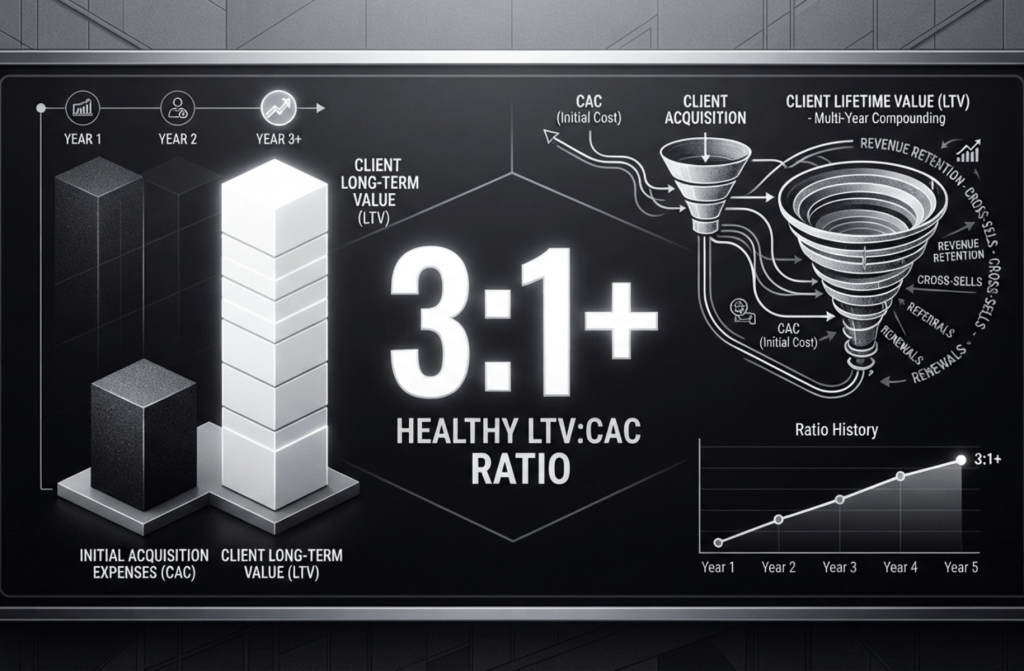
Here is the turn, and it is the whole point. The cost to acquire an advisory client, seen in isolation, can look alarming, far higher than a business owner used to “free” referrals expects. But it is the wrong number to look at alone. An advisory relationship is not a one-time sale. It is a multi-year relationship, often compounding as the client’s assets grow. Measured against that lifetime value, an acquisition cost that looked frightening becomes entirely rational.
The metric that matters is the relationship between lifetime value and acquisition cost, not acquisition cost on its own. A firm that understands its own ratio can spend confidently where a firm staring at CAC in isolation freezes.
What moves the number
Acquisition cost is not fixed. It is driven down by the things a good partner improves: a tighter niche, which makes every dollar of targeting more efficient; a stronger foundation, which converts more of the traffic you already pay for; and better follow-up, which rescues the prospects who were interested but not yet ready. Most firms leave enormous savings on the table not by overpaying for traffic but by under-converting the traffic they already have.
Where to go from here
Knowing your acquisition cost is what turns marketing from an act of faith into a decision you can make with your eyes open. If you have never run the number, that is the place to start, and it is a conversation worth having before you scale spend, not after. Book a call with us a https://legacygrowth.life to learn more




 Legacy Growth Blog
Leave a comment