
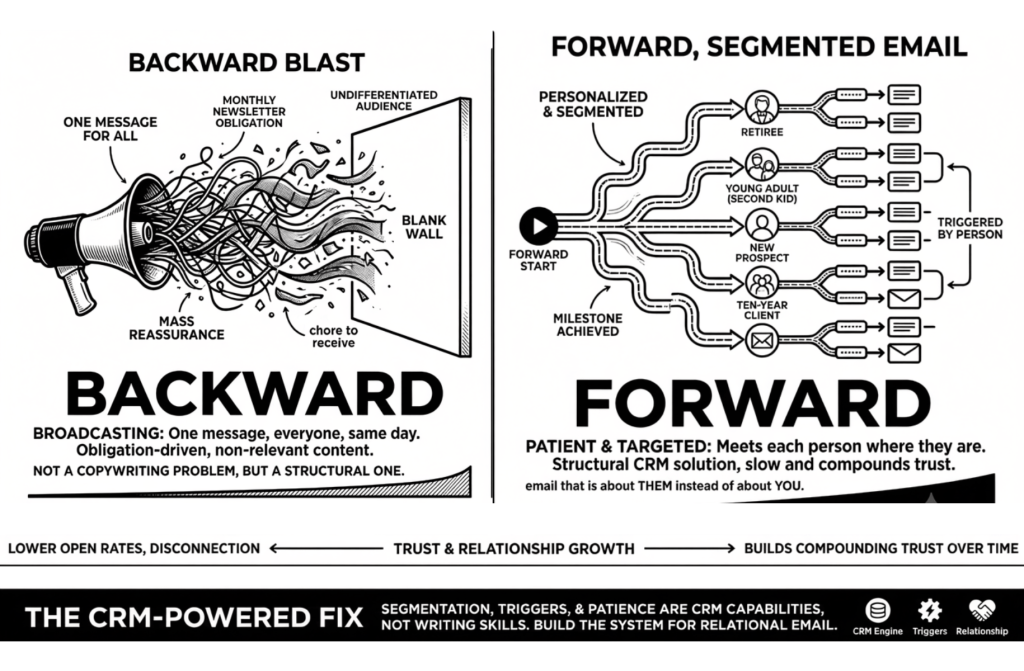
I want to describe the email program at a typical advisory firm, and I want you to tell me if it sounds familiar. There is a monthly newsletter that goes to everyone, that almost no one opens, built mostly out of obligation. And then, when the market does something frightening, there is a reassurance blast: the “stay the course” email that goes out the same week every other advisor sends theirs.
That is most advisor email. And it is backwards.
What backwards looks like
Backwards is broadcasting. One message, everyone, same day. It leads with the firm’s content, our newsletter, our market take, our commentary, rather than the client’s moment. It treats a list of hundreds of relationships at wildly different life stages as a single undifferentiated audience. And because it is built on obligation rather than intention, it feels like a chore to send and reads like one to receive.
None of that is a copywriting problem. You cannot write your way out of it with a cleverer subject line. It is a structural problem, and it has a structural fix.
What forward looks like
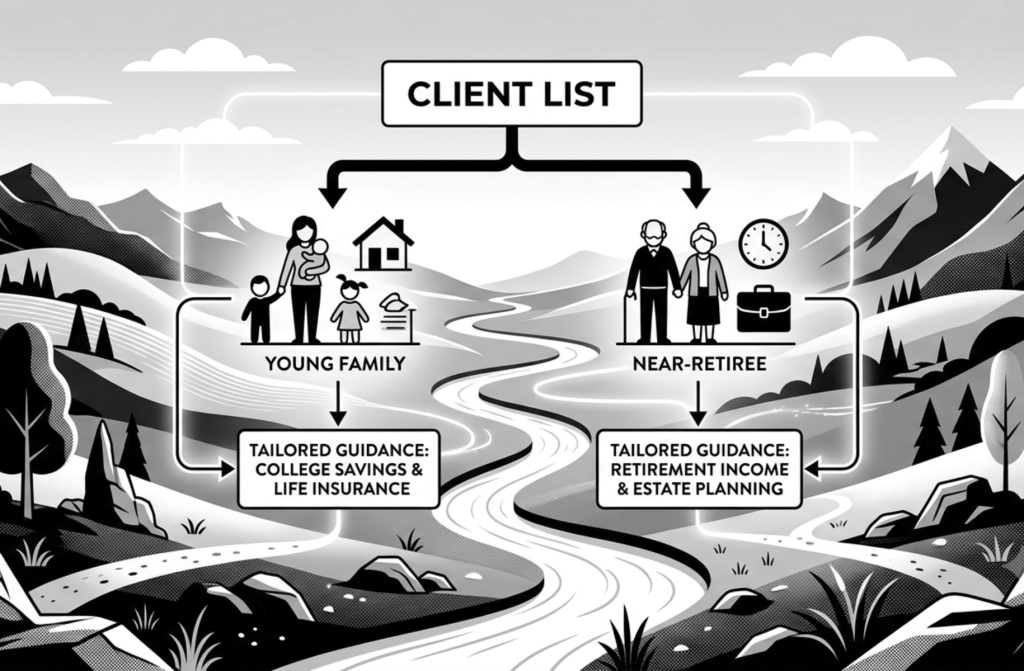
Forward is patient, segmented, and triggered by the person rather than the calendar. The retiree three years out does not need the same message as the thirty-five-year-old who just had a second kid. The prospect who downloaded your guide last week is in a different moment than the client you have had for a decade. Forward email meets each of them where they actually are.
The triggers are marketing moments, not investment advice: someone hit a milestone, someone went quiet, someone engaged with a specific topic, someone crossed an anniversary with the firm. Each is a reason to say something relevant to that person, at a time when it actually lands. That is the whole difference. It is not more email. It is email that is about them instead of about you.
Why it’s slow, and why that’s the point
Here is the part nobody wants to hear: this does not produce a spike. You will not send the first segmented sequence and watch the calendar fill. It compounds. Trust accrues over months, and the firms that win with email are simply the ones that did not quit at month three, when it looked like nothing was happening.
That is not a bug in the strategy. It is the strategy. The slow, steady, sustainable channel is the one your competitors abandon, which is exactly why it becomes yours if you stay with it.
Where email meets the CRM
All of this lives or dies on the system underneath. Segmentation, triggers, and patience are CRM capabilities, not writing skills. If your CRM is really just an address book, a place names go to be forgotten, then forward email is impossible no matter how good the copy is. Build the system, and the email that felt like a chore becomes something closer to a relationship that runs on its own.
If your email program is the broadcast-and-blast version, you are not doing email marketing badly. You are doing a different, worse thing that happens to use email. The fix is not writing more. It is building the engine underneath. Book a call with us a https://legacygrowth.life to learn more





 Legacy Growth Blog
Leave a comment