

Imagine this for a moment.
You come across a company online for the first time.
Maybe you saw a short post. Maybe someone shared an article. Maybe the founder appeared in a podcast conversation.
You’re curious, but you’re not ready to buy anything.
So you move on.
A week later, the brand appears again.
This time it’s a thoughtful article explaining a problem you’ve been dealing with.
You read it.
It’s helpful.
Still, you’re not ready to buy.
Another week passes.
You receive a newsletter from the same company. The message isn’t pushing a product. It’s simply sharing something useful the team learned while working with clients.
You read that too.
Then a few weeks later, you see a video explaining the exact issue you’ve been trying to solve.
At this point, something subtle has changed.
You trust them.
When the moment comes that you actually need help solving the problem, the decision feels easy.
You already know who to call.
That is the power of an invisible sales engine.
Most Sales Don’t Happen When You Think They Do
Traditional sales strategies often assume that persuasion needs to happen quickly.
An advertisement appears.
A promotion follows.
Urgency is introduced.
The hope is that pressure will accelerate the decision.
Sometimes it works.
But in markets where trust matters, this approach often creates resistance instead of confidence.
Because people rarely want to feel pushed into a decision.
They want to feel ready for it.
And readiness almost always develops over time.
The Relationship Before the Transaction
When businesses rely only on aggressive sales tactics, they skip an important stage of the buyer’s journey.
The relationship.
Customers want to understand who they are dealing with.
They want to observe how the company communicates.
They want to see how the brand thinks about the problem they’re trying to solve.
This process doesn’t usually happen in a single interaction.
It happens through repeated exposure to helpful insights, thoughtful explanations, and consistent communication.
Each interaction quietly builds familiarity.
And familiarity gradually builds trust.
Nurture Is What Happens Between Discovery and Decision
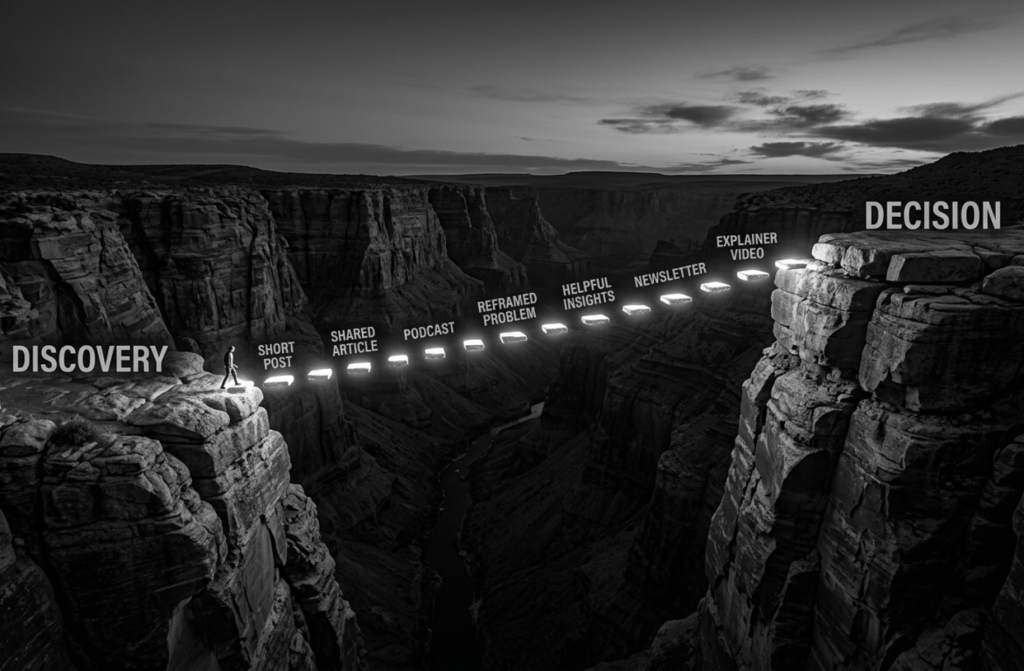
Nurture systems live in the space between first discovery and final purchase.
This space is where most decisions are actually formed.
It’s where potential customers learn more about the brand.
It’s where they begin to understand the company’s perspective.
It’s where they decide whether the business feels credible.
Without nurture, that middle space often disappears.
A brand either pushes immediately for a sale or disappears entirely until the next promotion.
But nurture keeps the relationship alive.
Not through pressure.
Through relevance.
What a Healthy Nurture System Looks Like
Strong nurture systems rarely feel like marketing.
They feel like ongoing conversations.
An email arrives that explains a new insight.
A thoughtful article appears that reframes a common problem.
A founder shares a lesson learned from working with clients.
None of these interactions are aggressively promotional.
Yet each one strengthens the relationship.
Over time, the audience begins to associate the brand with clarity and expertise.
And that association becomes the foundation for future decisions.
Why Pressure Often Backfires
High-pressure sales tactics rely on urgency.
Limited-time offers.
Countdown timers.
Scarcity messaging.
While these tactics can create quick action, they can also create doubt.
Customers may wonder if the decision is being rushed.
Or whether the urgency is genuine.
Nurture systems remove that tension.
Instead of forcing a decision, they allow trust to develop naturally.
And when someone eventually chooses to buy, the decision feels voluntary rather than coerced.
That difference matters.
Because confident customers are far more likely to become loyal ones.
The Long Game of Trust

An invisible sales engine doesn’t try to close every prospect immediately.
It plays a longer game.
It assumes that not everyone is ready today.
But many people will be ready eventually.
By remaining present through consistent, thoughtful communication, the brand stays connected to those future decisions.
Months later, when the timing is right, the brand is already familiar.
Already trusted.
Already associated with the solution.
At that point, the sale almost feels inevitable.
Why Nurture Systems Scale So Well
The beauty of nurture systems is that they work continuously.
Once the architecture is built, the system begins to support every new relationship automatically.
A new subscriber enters the ecosystem.
They receive helpful insights.
They learn how the brand thinks.
They become more familiar with the company over time.
Meanwhile, the team continues doing what they do best.
Serving clients.
Solving problems.
Developing new ideas.
The system carries the relationship forward quietly in the background.
The Sales Process You Rarely See
From the outside, it may look like some businesses simply attract the right customers effortlessly.
Leads arrive already informed.
Prospects already understand the company’s philosophy.
Sales conversations feel easy.
But this ease is rarely accidental.
It is usually the result of an invisible engine working behind the scenes.
Content.
Communication.
Education.
Consistency.
Each piece nurturing the relationship long before the sales conversation ever begins.
Final Thought
Sales does not always happen at the moment of the pitch.
In many cases, the real decision happens weeks or months earlier.
It happens while someone is reading your insights.
Listening to your ideas.
Observing how your brand shows up over time.
By the time they reach out, the decision has already been made internally.
That is the quiet power of nurture systems.
They allow trust to form long before the sale ever begins.
And when trust leads the process, selling no longer feels like pressure.
It feels like the natural next step.

Book Your Discovery Call
Most businesses do not struggle because they lack marketing tools.
They struggle because their growth systems were never designed to build trust and authority at scale.
At Legacy Growth, we don’t sell hacks. We build durable growth infrastructure.
If you want your time back, your energy back, and your growth back, let’s talk.
➡️ Book a strategy call with LegacyGrowth.life
We’ll audit your current work structure, show you exactly what to delegate, and help you build a VA system that compounds.
No gimmicks. Just execution that actually works.






Leave a Reply