


Here is the reframe that reorients everything: if you advertise, you are publishing regulated communications, whether or not you have ever thought of it that way. Not just your paid ads. Your website. Your LinkedIn posts. The testimonial on your homepage. The third-party rating in your email signature. Under the SEC Marketing Rule, Rule 206(4)-1 under the Investment Advisers Act, all of it can be “advertising,” and all of it carries obligations.
For advisors, that is not a reason to go quiet. It is a reason to understand the rule well enough to market confidently inside it. Here is the plain-English version.
What counts as an “advertisement”
This is the part that surprises people. The Marketing Rule’s definition of an advertisement is broad. In general terms, it captures communications an adviser makes that offer the adviser’s services to prospective clients or investors, and it reaches across the media most firms do not think of as “advertising” at all, including websites, social media posts, and marketing emails. It also specifically brings testimonials, endorsements, and third-party ratings into scope.
The practical takeaway: there is no “casual” channel. A LinkedIn post from the founder is subject to the same framework as a paid campaign. Once you accept that, everything downstream gets simpler, because you stop drawing false lines between “marketing” and “just posting.”
The seven general prohibitions
Underneath the detail, the rule is anchored by a set of general prohibitions that apply to every adviser advertisement. In plain terms, an advertisement may not: make an untrue statement or omit a material fact; include a material statement of fact the adviser cannot substantiate on demand; create an untrue or misleading implication; present benefits without fair and balanced treatment of material risks or limitations; reference specific advice in a way that is not fair and balanced; present performance in a way that is not fair and balanced; or otherwise be materially misleading. Almost everything else in the rule is a specific application of these principles.
The substantiation requirement
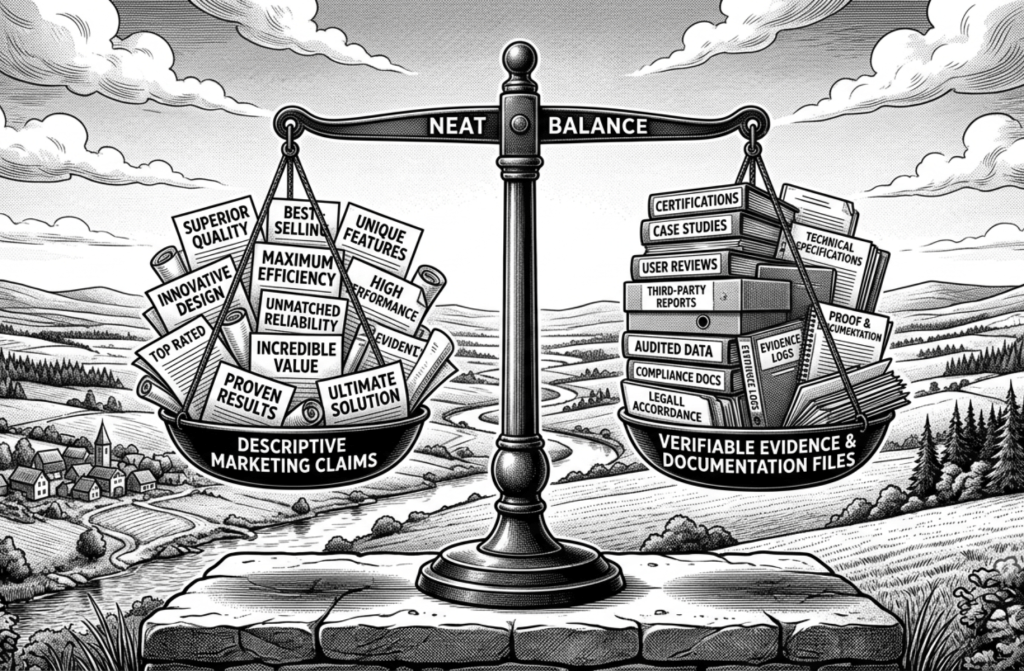
The rule requires that advisers have a reasonable basis for believing they can substantiate material statements of fact upon demand. In plain terms: if you say it, you must be able to prove it, and you should expect that you may be asked to.
This reshapes ordinary marketing copy. “Award-winning,” “top-ranked,” “trusted by hundreds of families”, each is a factual claim that now needs evidence behind it, not just a nice ring. The discipline this creates is healthy: it pushes advisor marketing toward specific, defensible, honest language and away from the inflated adjectives that make most financial advertising blur together.
Performance advertising: the high-risk zone
If there is one area to treat with genuine caution, it is performance. The rule sets specific conditions around how performance may be presented, including requirements built to prevent cherry-picking favorable periods or results, and to ensure results are shown with appropriate context and net of fees. This is the corner of the rule most likely to create real problems, and it is also the one where the temptation is greatest, because strong results are exactly what a proud firm wants to show.
The safe posture for most marketing is to avoid leading with performance at all. Trust in wealth management is built far more by demonstrating judgment and understanding than by advertising returns, and the marketing that demonstrates judgment carries a fraction of the regulatory risk. When performance advertising is genuinely warranted, it belongs in the hands of compliance from the first draft, not the last.
Note Performance advertising has specific, technical requirements, including net-of-fees calculation and prescribed time periods, that go beyond the scope of this overview, and staff guidance on points like model fees continues to evolve. Do not design performance advertising from this post. Involve compliance counsel directly.
Testimonials and endorsements: allowed, with conditions
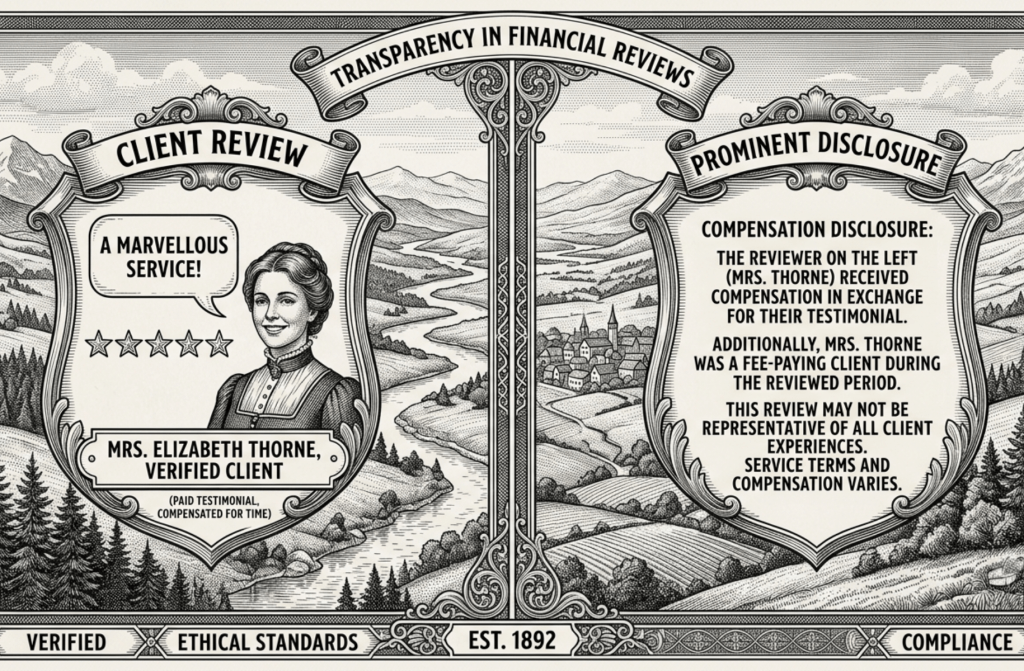
This is the headline change advisors tend to have heard about: testimonials and endorsements, long effectively off-limits, are now permitted, but only when specific conditions are met. In general terms, those conditions fall into three groups: required disclosures, adviser oversight and compliance obligations, and promoter disqualification provisions.
The disclosures are the part that trips firms up most often. An advertisement using a testimonial or endorsement must clearly and prominently disclose whether the promoter is a client and whether they were compensated, along with additional disclosure about compensation and material conflicts of interest. “Clear and prominent” is meant literally, burying it in a footnote or behind a hyperlink does not satisfy the requirement. There are specific conditions and limited exceptions, including for certain affiliated persons and for arrangements below a de minimis compensation threshold, and a written agreement is required in certain cases.
What that means in practice is that the ordinary social-proof playbook, grab a happy client quote, put it on the site, becomes a compliance event rather than a casual win. This is not theoretical: the SEC’s exam staff flagged testimonial and endorsement disclosure failures as a focus area heading into 2026. The upside is real, authentic endorsement is powerful, and it is now available to advisors who handle it correctly. The requirement is that “correctly” is not optional.
Third-party ratings
Ratings and “top advisor” lists sit in a related category with their own conditions, including a due-diligence obligation to confirm the rating gave equal opportunity for favorable and unfavorable responses, and disclosure about the criteria and the period involved. A ranking based on assets alone, for instance, says nothing about advice quality, and the disclosure is expected to make that honest.
Recordkeeping: the part agencies forget
The rule carries recordkeeping obligations, and they extend to marketing in ways that catch production teams off guard. Advisers must retain their advertisements along with supporting documentation. For an agency, that means the archive is not a filing cabinet at the client’s office, it is a requirement that lives inside the creative process itself: every variant, every iteration, retained with the evidence behind any factual or performance claim.
A production model that does not build archival in from the start is quietly creating a recordkeeping gap for its clients. A good one treats retention as part of shipping, not as an afterthought.
A practical pre-publish checklist
None of the above requires a law degree to operationalize. It requires a habit. Before anything goes out the door, an ad, a post, a page, an email, run it against a short set of questions:
| Before you publish anything | Ask |
|---|---|
| Is it an advertisement? | Does this reach more than one person? Website, post, email, ad, review, if yes, treat it as regulated. |
| Can you back it up? | Is every material statement of fact substantiable with evidence you actually hold and could produce on demand? |
| Is it fair and balanced? | Does it present benefits without hiding material risks or limitations, and avoid misleading implications? |
| Does it make a performance claim? | If it references results, are the required context and disclosures present? If unsure, route to compliance before it goes out. |
| Is there a testimonial, endorsement, or rating? | Are the disclosures (client status, compensation, conflicts) clear and prominent, and is oversight and any written agreement in place? |
| Is it archived? | Is every version being retained per the recordkeeping rule, with supporting documentation for factual claims? |
This checklist is a starting discipline, not a compliance program. It is the difference between a team that respects the rule and one that stumbles into it.
How this shapes the way we work
Everything above is why marketing for advisors is a specialist’s job, not a generalist’s. It is why we build from pre-cleared creative libraries, so that new work moves through review as adjustments rather than cold reviews. It is why we build compliance review into the production loop instead of bolting it on at the end. And it is why archival is part of how we ship, not a favor we remember to do later.
The rule is not the obstacle advisors are told it is. It is the reason the work has to be done by someone who knows the terrain, and knowing it well is what lets a firm market with confidence instead of fear.
Where to go from here
If you have been holding back on marketing because the compliance picture felt like a minefield, the answer is not to stay quiet. It is to build a presence with a team that treats the rule as a first-class constraint from the first draft. That is a conversation worth having.Book a call with us a https://legacygrowth.life to learn more





 Legacy Growth Blog
Leave a comment