

Every week, someone figures out a new trick to beat the algorithm. A posting time. A hook format. A caption length. A hashtag cluster. A new type of video cut that the platform happens to be rewarding right now. And for about three to six weeks, it works beautifully. Engagement climbs. Reach spikes. Follower counts tick upward. There is a brief, intoxicating window where it feels like you have cracked the code. And then, without warning or explanation, the numbers flatten. The reach drops. The trick stops working. The audience that briefly showed up has moved on to the next thing.
That is not a glitch. That is the algorithm doing exactly what it was designed to do.
Platforms are not built to sustain your business. They are built to sustain attention. And attention is an endlessly moving target. The moment any content format gets too predictable, too widespread, too easy to replicate, the algorithm deprioritizes it. It has to. Its job is novelty, not loyalty. Its mandate is to keep users scrolling, not to keep your revenue consistent.
Understanding this distinction is not a small thing. It is foundational. Because the brands that understand it build differently than the brands that do not. And the difference in outcomes, measured across two or three years, is not incremental. It is categorical.
Why Chasing the Algorithm Keeps You Stuck in a Loop
Here is the uncomfortable truth most marketing content will not tell you: if your entire growth strategy depends on cracking a platform’s algorithm, you are renting your audience from a landlord who can raise the rent or change the locks at any time, without notice, without recourse, and without any obligation to explain why.
We have watched this play out in real time, repeatedly, across multiple platforms and multiple market cycles. The organic reach collapse on Facebook in 2018 wiped out years of page-building work overnight for thousands of businesses that had invested heavily in that channel. The LinkedIn algorithm reshuffling of 2023 cut impressions for many creators by 40 to 60 percent in a matter of weeks. TikTok has oscillated between rewarding business content and throttling it so many times that entire agency models have been built and dismantled around the platform’s preferences. Instagram has changed the rules on Reels, carousels, and link placement so frequently that what worked six months ago is often actively counterproductive today.
None of these changes were telegraphed. None came with a grace period. Creators and brands that had built their entire identity and lead flow around one platform’s rules lost months, sometimes years, of momentum in a single news cycle.
And yet, despite this pattern playing out over and over again, the most common question we hear from new clients is still some version of: what is working on the algorithm right now? It is an understandable question. It is just not the right one.
The right question is not what the algorithm rewards today. The right question is what your audience will still trust you for two years from now, regardless of what any platform decides.
The Anatomy of an Omnipresent Engine
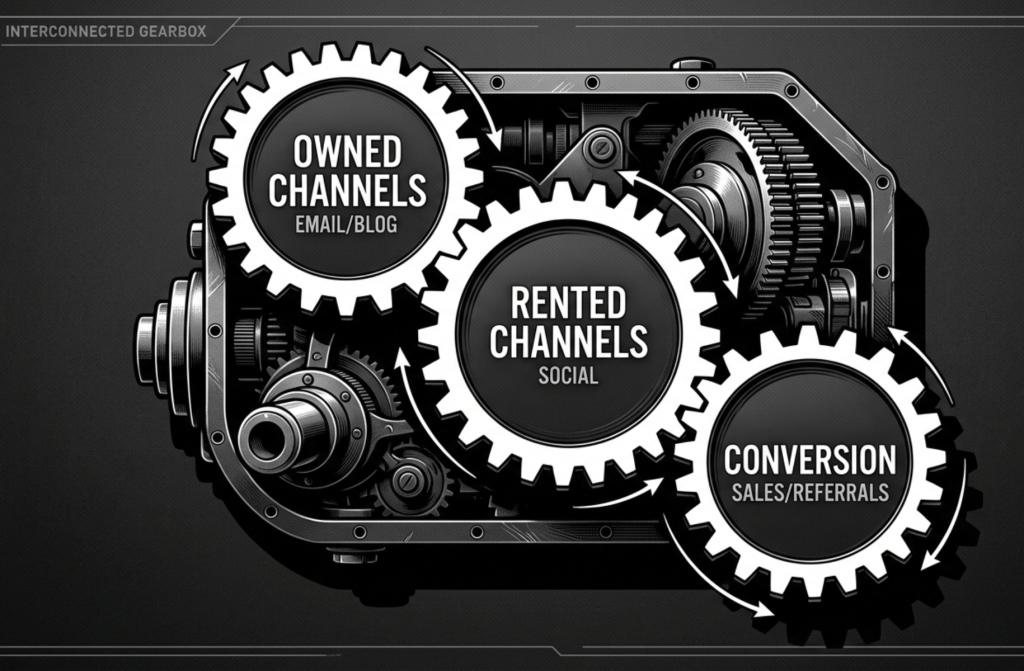
At Legacy Growth, we talk a lot about what we call the omnipresent engine. It is not about being everywhere at once for the sake of volume. It is not about posting five times a day across six platforms and hoping something lands. It is about showing up consistently across a carefully chosen mix of owned and rented channels so that no single platform failure can take you down, and so that your audience encounters you in multiple contexts over time.
The distinction between owned and rented channels is critical and not discussed nearly enough. Your social media presence is a rented storefront. You did not build the platform. You do not set the terms. You cannot take your audience with you if the platform changes or disappears. But your email list is property you own outright. Your blog, your podcast, your YouTube channel, your SMS subscriber list: these are assets that compound over time regardless of what any algorithm decides to do next Tuesday.
When these channels work together, each one feeding the others, you stop being at the mercy of any single gatekeeper. A spike in Instagram reach becomes an email list grow. An email sequence drives traffic to your blog. Your blog builds domain authority that ranks you in organic search for years without any additional spend. Your podcast builds an intimacy with listeners that no social post can replicate. A well-produced YouTube video answers your audience’s questions at two in the morning when no one on your team is available. The engine feeds itself.
The brands we see winning consistently are not the ones with the most social followers. They are the ones with the most robust infrastructure underneath their social presence. The ones where social is the front door, not the whole building.
Platform Volatility Is Accelerating, Not Slowing Down
One of the arguments we sometimes hear against investing in owned channels is that social platforms have been around long enough now that their algorithms are more stable than they used to be. This is not supported by what we are observing. If anything, algorithmic volatility is increasing as platforms compete more aggressively for time on screen and as AI-generated content floods every feed simultaneously.
When any platform is trying to distinguish high-quality original content from a rising tide of AI-produced filler, the rules for what gets amplified shift constantly. Platforms are in an arms race against their own content supply. The signal-to-noise ratio is getting harder to manage, and their algorithmic responses to that challenge will continue to create unpredictability for anyone building on rented ground.
This is not a reason to panic. It is a reason to build smarter. The volatility in rented channels makes the stability of owned channels more valuable, not less. Every email subscriber you earn today is a direct line to that person that no algorithm can interrupt. That is not a small thing in a world where organic reach continues to compress.
Authenticity Cuts Through Where Algorithms Cannot
Here is what we have observed across every client vertical we serve, from wellness coaches to SaaS founders to e-commerce brands to professional service firms: the content that consistently outperforms everything else is not the most optimized content. It is the most real content.
A behind-the-scenes video filmed on a phone that shows what a real day in the business looks like. A candid email that admits something did not go the way you planned and shares what you learned. A blog post that takes an honest position on something the industry avoids saying out loud. A social post that asks a genuine question rather than performing authority. These pieces generate trust in a way no algorithm optimization can manufacture.
The reason is simple. Optimization produces content that is technically correct. Authenticity produces content that is emotionally true. And people do not buy from technically correct brands. They buy from brands they trust. They buy from brands they feel seen by. They buy from brands that seem to understand their actual problem rather than just performing expertise about it.
And trust, once built, is recession proof in a way that reach never is. A follower who trusts you becomes a buyer. A buyer who trusts you becomes a repeat customer. A repeat customer who trusts you becomes a referral source. A referral source who trusts you becomes a case study. That chain of compounding value starts with authenticity, and no trending audio clip has ever created it.
What This Means for How You Build Your Content Strategy
You do not need to abandon social media. Social platforms are still one of the most efficient ways to introduce your brand to new audiences, and we use them aggressively for every client we work with. But you need to stop treating social reach as the ceiling of your strategy rather than one floor of a much larger structure.
Every piece of content you create should have a job beyond getting engagement on the platform where it lives. It should be driving people somewhere: to a blog that adds depth, to a lead magnet that earns the email address, to a discovery call, to a community, to a longer piece of content that demonstrates your real expertise. If your content is generating likes and comments but producing no movement toward a business outcome, it is entertainment spending disguised as marketing.
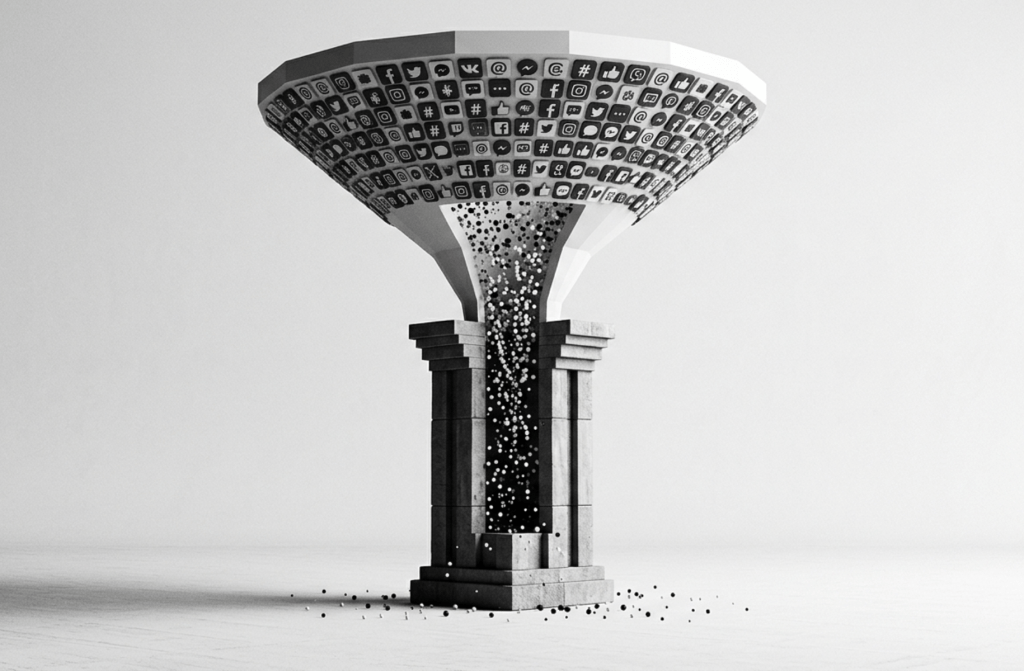
The reframe we push our clients toward is this: think of your social content as top-of-funnel awareness, and think of your owned channels as the actual business. Build the awareness aggressively. But build the infrastructure even more aggressively. The awareness without the infrastructure is a wave with nowhere to break.
The Long Game Is the Only Sustainable Game
There is a version of social media success that looks impressive from the outside and produces very little on the inside. High follower counts, consistent engagement, regular virality, and almost no email list growth, almost no repeat customers, almost no referral traffic, almost no compounding asset of any kind. The brand is entirely dependent on its continued performance on a single rented platform. It is a treadmill, not a business.
The alternative requires patience that most marketing culture actively discourages. It requires publishing blog content for six months before it ranks. It requires sending emails to a small list before it becomes a big one. It requires building a podcast audience one episode at a time. None of this feels as immediate as a viral post. But the outcomes it produces are qualitatively different. An email list of ten thousand engaged subscribers who trust you is a more durable business asset than a million social followers who do not.
The algorithm will change again. It changed last month. It will change next month. It will change in ways we cannot predict, on timelines we cannot anticipate, for reasons that serve the platform rather than the people building on it. The businesses that thrive through every shift are the ones that treated each platform as one chapter in a longer story, not the whole book.
Build the engine. Own the audience. Show up with something real. That combination is what creates authority that lasts beyond any viral moment, survives any algorithm update, and compounds into something that can genuinely be called a legacy.
Related reading: How we build omnipresent content systems for clients
Related reading: More on long-term authority building
Ready to build a brand that compounds over time? Visit us at legacygrowth.life to start the conversation.






Leave a comment