

Every founder has seen it happen. A competitor posts something and it takes off. Hundreds of thousands of views in 48 hours. Shares cascading across platforms. Comments flooding in. DMs overflowing. For a brief and dazzling window, that person or brand seems to be everywhere, the topic of conversation in every group chat, the name getting dropped in every industry thread.
And then, six weeks later, they are nowhere. The audience that momentarily noticed them has moved on to the next interesting thing. The follower count bump was real but the followers are not engaging. The email list barely moved. Revenue is approximately where it was before the moment happened. The opportunity came and went, and the business looks almost identical to how it did before the wave.
This is one of the most common and most painful experiences in modern marketing. Not because virality is inherently bad, but because virality without infrastructure is a wave that has nothing to deposit when it reaches the shore. The water rushes in, impressive and loud, and then rushes back out, and the beach looks the same as it always did.
Understanding why this happens, and what you need to build to prevent it, is one of the most practically valuable things a founder or marketing leader can invest time in understanding.
What a Viral Moment Actually Does
A viral moment is, at its most precise definition, awareness at scale delivered in a compressed timeframe. That is its primary function. It puts your name, face, or brand in front of a large number of people very quickly. In theory, this should translate directly into business outcomes: more followers, more leads, more customers, more revenue. In practice, it only does so if the infrastructure is already in place to capture and convert that attention when it arrives.
Awareness without a clear next step is borrowed attention. If someone watches your viral video and there is no compelling reason to follow you embedded in the content itself, no link to something of value in the caption, no offer or invitation that matches the emotional state the content created, they will leave the way they came in. Curious, maybe mildly entertained, and entirely uncommitted. They will scroll to the next thing within seconds, and they will not think about you again.
The businesses that do convert viral moments into lasting growth have one thing in common: they had already built the destination before the wave arrived. The email opt-in was set up and the lead magnet was ready. The website told a clear, compelling story about who they were and why someone should care. The social profile had enough depth, enough content, enough consistent presence that a new visitor could spend five minutes scrolling and come away with a genuine sense of the brand. The offer was clear and the path to it was obvious.
None of those things get built in the 48 hours after a post goes viral. They have to be built before. And most businesses that experience a viral moment and fail to capitalize on it simply had not built them yet.
The Invisible Work That Makes Moments Matter
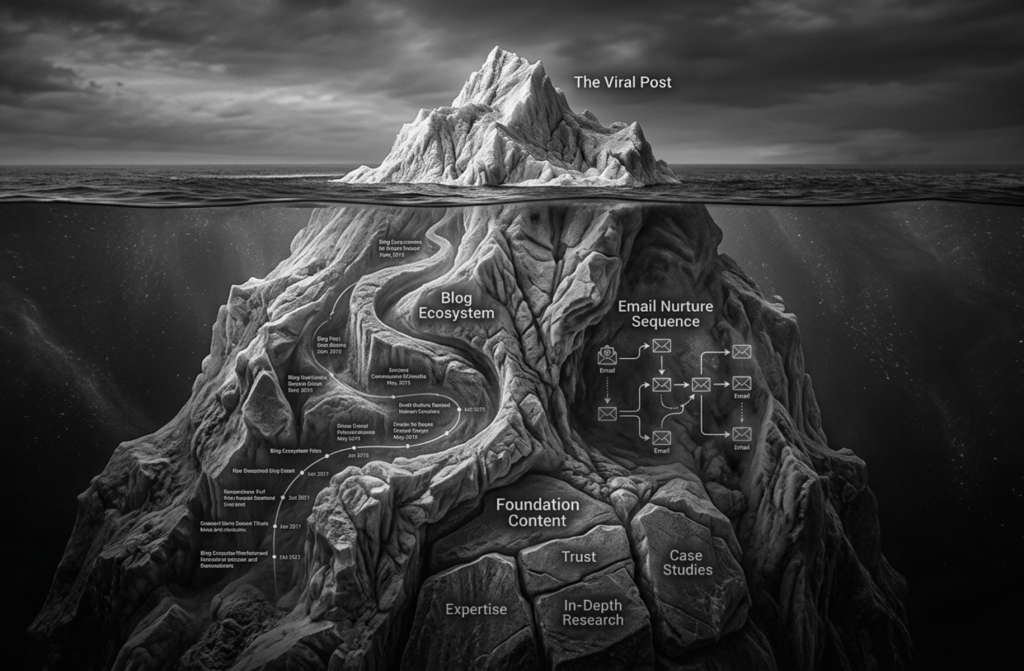
The paradox of building lasting authority is that most of the work happens when no one is watching. The blogs you publish consistently for six months before any of them rank on the first page of Google. The email sequences you write and refine and test before the list is large enough for the tests to be statistically meaningful. The podcast episodes you record and edit when the download numbers are still in double digits. The social content you post week after week before the algorithm decides your account is worth amplifying.
This invisible work is not glamorous. It does not attract attention while it is happening. No one is writing think pieces about your disciplined content cadence or your thoughtfully constructed email nurture sequence. The moments that look impressive from the outside are almost always the result of a long period of unglamorous, consistent work that happened entirely out of view.
The viral post that went wide was the fifteenth iteration of a format the creator had been refining and testing for months. The product launch that generated six figures in 72 hours was built on an email list that had been nurtured weekly for two years. The speaking invitation that created a flood of inbound leads came because that founder had been publishing expertise consistently long enough that the event organizer had been watching them for a year before reaching out.
There are no shortcuts to this. There are tools that make the production faster, systems that make the distribution more efficient, and strategies that make the whole process more targeted and effective. But the accumulation of trust and authority that makes moments matter when they come cannot be manufactured in a sprint. It has to be grown.
Shortcuts exist. But they tend to produce outcomes that also feel like shortcuts: brief, bright, and forgettable.
The Conversion Misalignment Nobody Warns You About
Here is the specific failure mode we see most often with brands that experience a viral moment and do not capitalize on it, and it is more nuanced than simply not having an email opt-in ready. The problem is often that the content that went viral and the offer the brand was trying to sell were not aligned in a way that made the audience’s next step feel natural and obvious.
Someone goes viral for a funny, sharply observed, deeply relatable post about a frustration common in their industry. Thousands of people follow them. New visitors land on their profile and see, pinned at the top, a link to a $12,000 high-ticket consulting program. The context switch is jarring. The trust is not there yet. The relationship has not been established. The conversion rate is essentially zero.
Or a wellness brand posts a video that strikes an emotional chord around a particular aspect of mental health, and it spreads. The comments are full of people saying they feel seen. And then those people visit the brand’s website and encounter… a confusing product catalog with no clear entry point for someone who just had an emotional response to a piece of content. The moment of connection has no place to go. It dissipates.
Building a real audience, the kind that actually converts into customers and clients and advocates, means thinking deliberately about the journey from first encounter to committed relationship. Awareness to interest. Interest to consideration. Consideration to trust. Trust to action. That journey cannot be skipped. It can be compressed with excellent content and smart strategic sequencing, but the steps cannot be eliminated. A viral moment puts people at the very beginning of that journey. You still have to walk them through the rest of it, and you need infrastructure that is designed to do that walking automatically and effectively.
Building the Foundation Before the Wave Arrives

The practical implication of everything above is that the best time to build your audience infrastructure is not when a moment is happening. It is long before one arrives. The lead magnet should already be written and tested. The welcome email sequence should already be live. The cornerstone blog posts that demonstrate your expertise at depth should already be published and beginning to rank. The offer page should already be converting at a rate you understand and have optimized. The social profile should already tell a coherent story.
When you have all of this in place, and then a piece of content breaks through to a wider audience, the impact is categorically different. The new visitors land on a profile with depth and history. They click the link and find a clear offer with obvious value. They enter the email sequence and spend the next two weeks being educated and nurtured into trust. The wave breaks on a shore that was built to receive it, and it deposits something lasting rather than washing back out to sea.
This is not complicated as a concept. The difficulty is entirely in the execution, specifically in the willingness to build the infrastructure during the periods when there is no wave in sight. To write the email sequences when the list has 200 people on it. To publish the blog posts when the traffic is minimal. To invest in the foundations when there is no immediate payoff in sight. Most businesses find this very hard to sustain. The ones that manage it are the ones whose viral moments change their trajectory rather than just their analytics.
What Long-Term Authority Actually Looks Like in Practice
True category authority, the kind that makes you the first name that comes to mind when someone in your market has a problem you solve, is not built in a single moment or a single campaign. It is built through the accumulated weight of consistent expertise demonstration over time. It is built through the interconnected ecosystem of content that each piece reinforces and amplifies: blogs that link to each other and to deeper resources, social content that drives to longer pieces, emails that reference past conversations and build on established context, a website that tells a coherent and progressively deepening story about who you are and what you know.
When this ecosystem is functioning well, each piece of content makes every other piece more credible. A new visitor who finds you through a social post can click through to a blog post that goes much deeper on the same topic, which links to a related piece that goes deeper still, which offers a lead magnet that earns the email address, which triggers a welcome sequence that introduces them to the full range of your expertise. By the time they have been in your world for two weeks, they have a genuine sense of your depth and capability. That is what authority feels like from the inside.
It takes time to build. It requires consistent investment of energy and attention when the payoff is not yet visible. But the brands that build it find themselves in a fundamentally different competitive position than the ones that do not. Their moments matter. Their campaigns convert. Their referrals compound. The foundation does exactly what foundations are supposed to do: it makes everything built on top of it more stable and more capable of reaching higher.
Related reading: How we build content ecosystems that convert at every stage
Related reading: More on authority building and long-form content strategy

Ready to build a brand that compounds over time? Visit us at legacygrowth.life to start the conversation.






Leave a comment