


Search intent is a gift, and advisors are structurally positioned to receive it. When someone types “fee-only advisor near me” or “financial advisor for physicians,” they are not idly browsing. They are further down the decision funnel than any social impression will ever put them. Google Ads lets you be there at that exact moment. The catch is that wealth management carries advertising constraints stricter than almost any other industry, and most agencies running advisor campaigns do not know them.
This is the compliance-first version of the guide. It assumes you want appointments you can forecast and that you would rather not create a regulatory problem to get them.
Why search intent works so well for advisors
The advisory relationship is high-trust, high-consideration, and long-term. That makes cold interruption inefficient and high-intent search efficient. Someone searching for an advisor has usually had a triggering event, a liquidity moment, a job change, a divorce, an inheritance, a retirement on the horizon, and is actively looking for someone to trust. You are not manufacturing the need. You are meeting it.
The advisor keyword landscape

Advisor search intent falls into a few recognizable buckets, and they are not equally valuable:
- Local intent, “financial advisor [city],” “wealth manager near me.” High intent, geographically bounded, competitive.
- Fee-structure intent, “fee-only advisor,” “fiduciary financial advisor.” Prospects who have done homework and self-selected for how you work.
- Life-event intent, “advisor for inheritance,” “retirement planning [city].” Triggered, timely, often the highest-converting.
- Niche intent, “advisor for physicians,” “advisor for tech employees with RSUs.” Lower volume, dramatically higher fit, usually lower cost per acquisition.
Financial keywords carry some of the highest costs-per-click in all of paid search, because the lifetime value of a client is high and every firm knows it. [verify: cite a current, sourced CPC benchmark for financial-advisor keywords rather than a remembered figure.] That cost is survivable only if the page the click lands on does its job, which is why landing-page quality matters more here than in cheaper verticals.
What you can and can’t say
Every word of ad copy is a regulated communication. In practice that means a few hard constraints on advisor search ads:
- No cherry-picked performance. You cannot advertise a strong result without the context the Marketing Rule requires. “We grew client assets by [X]%” in an ad headline is exactly the kind of claim that creates exposure.
- Substantiation. Any factual claim must be something you can back up on demand. “Award-winning” and “top-rated” are not free adjectives; they carry a burden of proof and specific disclosure requirements.
- Reviews and ratings are testimonials. Extending Google seller ratings or star reviews into ads pulls you into the testimonial, endorsement, and third-party-rating rules, which carry disclosure, oversight, and due-diligence obligations.
The full detail lives in our plain-English guide to the Marketing Rule. For campaign purposes, the safe zone is clarity about who you serve and how you work, rather than claims about what you have returned.
The landing page is the campaign
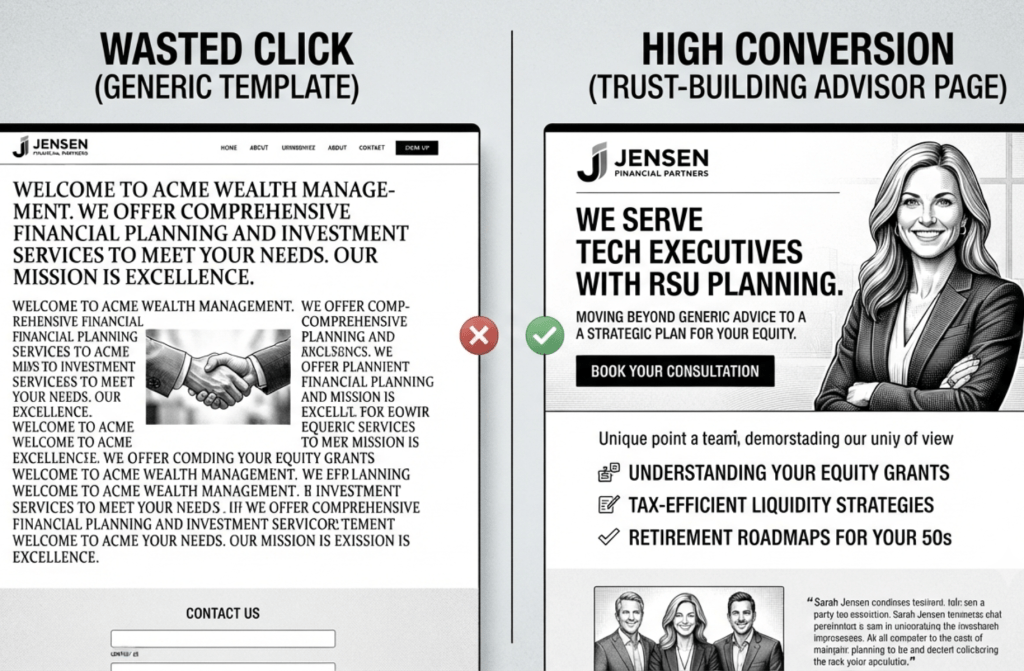
Advisor ads fail against thin sites. A prospect clicks, lands on a page that could belong to any firm, and leaves. A page that converts advisor traffic tends to share a few traits: it names who the firm actually serves, it demonstrates a point of view rather than listing services, it makes the next step obvious and low-friction, and it survives the reflexive “is this firm real” check by showing a genuine team and presence. None of that is exotic. It is just usually missing.
Tracking and the CRM handoff
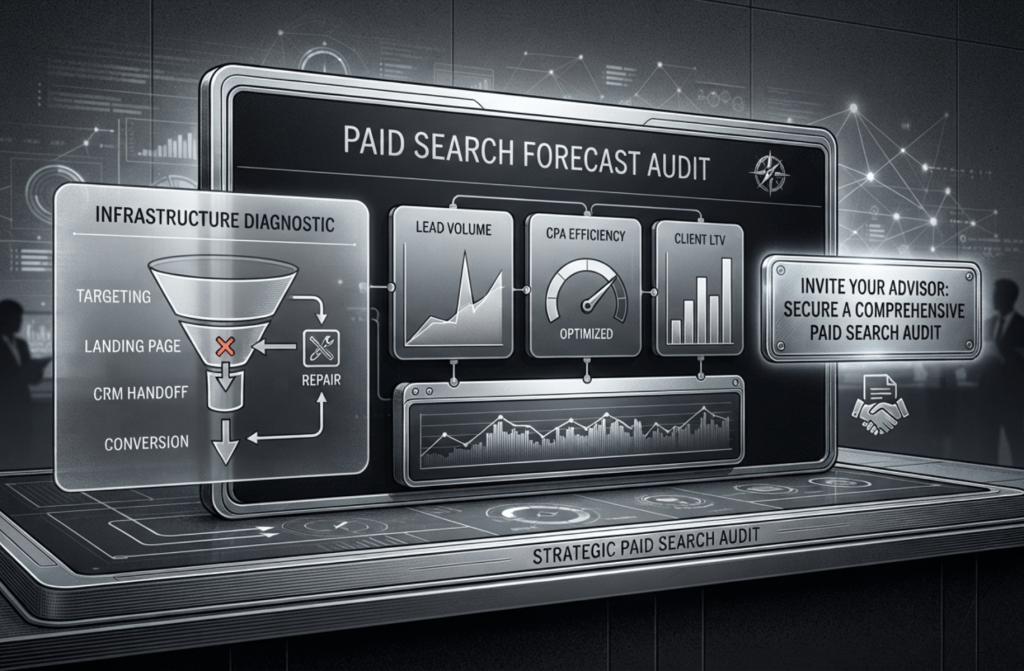
The most common place advisor ad spend evaporates is not the click. It is the seconds after it. A lead comes in and nothing catches it: no immediate confirmation, no nurture, no reminder when they go quiet. Paid search for advisors should be wired directly into a CRM that follows up automatically and consistently, because a high-value prospect who was not ready today is worth staying in front of for months.
Honest ranges beat confident promises, and anyone quoting you a guaranteed cost per lead for advisor search is guessing. Cost per lead is a function of niche, geography, competition, and the quality of the page behind the ad. A tightly niched campaign in a defined market can be dramatically more efficient than a broad “financial advisor” play in a major metro.
The number that actually matters is not cost per lead. It is cost per client measured against the lifetime value of a multi-year advisory relationship, which is the frame that makes a seemingly high acquisition cost perfectly rational. We break that math down in our piece on what client acquisition actually costs.
Where to start
Google Ads is one of the few channels that can make an advisor’s pipeline genuinely forecastable. It only works, though, on top of a foundation that converts. If the site behind the ad is not ready, the spend is premature.
That sequencing question, what to build before you turn on paid, is the right first conversation.
Book a call with us a https://legacygrowth.life to learn more




 Legacy Growth Blog
Leave a comment