

You have been consistent. You show up on Instagram every day, maybe LinkedIn, maybe TikTok. You have built something real there. An audience, a rhythm, a reputation that lives inside one platform’s walls. It feels like momentum.
Then the algorithm shifts. Reach drops 60 percent. Or an account gets flagged. Or the platform makes a decision that changes who sees your content and why. And you realize that every bit of equity you built was sitting on land you do not own, and the landlord just changed the lease without telling you.
Platform dependency is one of the most common and most quietly destructive risks in modern marketing. The businesses that survive algorithm shifts and platform volatility are not the ones who figured out the hack. They are the ones who never let any single platform become their whole strategy.
The Business You Built on Rented Land
We use that phrase, “rented land,” because it is the most accurate description of what social media platforms actually are for businesses. You do not own your Instagram audience. You do not own your TikTok following. You have access to those people only as long as the platform decides to show them your content, and only under whatever terms the platform sets today.
This is not a scare tactic. It is a documented business risk with a long history. Facebook organic reach dropped from roughly 16 percent to under 2 percent over three years in the early 2010s. TikTok has throttled accounts without explanation, reinstated them without explanation, and changed its algorithm visibly enough that entire content categories went from high reach to near-invisible within months. Instagram’s algorithm has been rewritten enough times that strategies that worked perfectly two years ago are now effectively useless.
Every one of those changes affected businesses who had built their marketing strategy around a single platform. And the businesses that felt it most were the ones who had no other mechanism for reaching their audience.
The question is not whether your platform will change. It will. The question is whether your business can absorb that change when it comes.
What Platform Dependency Actually Costs
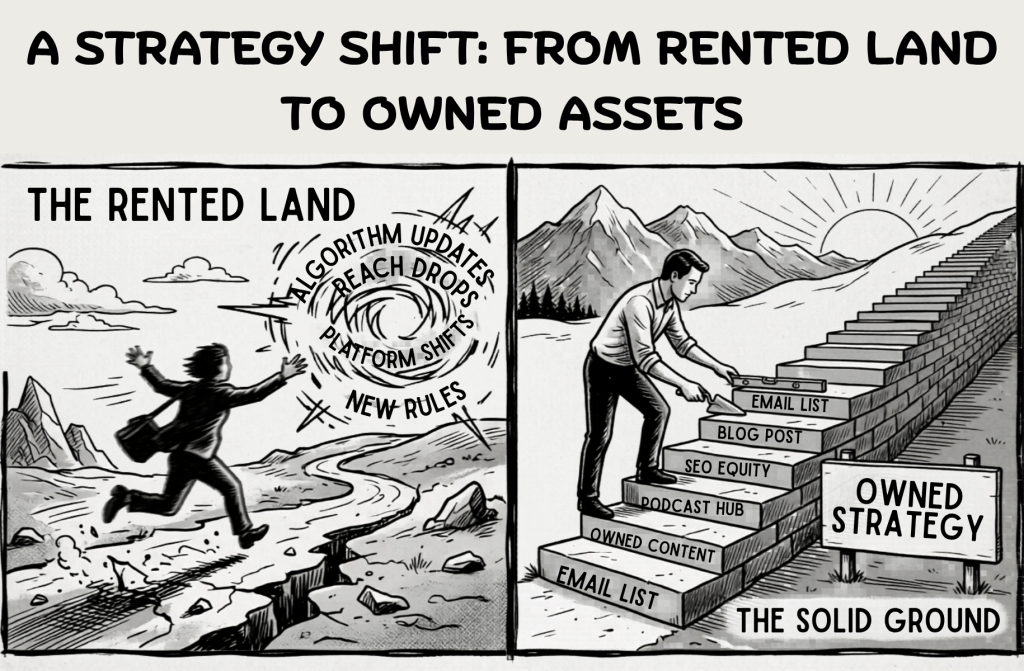
The obvious cost is reach. When a platform pulls back your visibility, fewer people see your content, fewer people click, fewer leads come in. The revenue dip is measurable, even if delayed.
But there is a less obvious cost that is harder to track and more damaging over time. Platform dependency makes you reactive. Instead of building a marketing strategy around your goals, your audience, and your long-term positioning, you are constantly adjusting to platform changes. Every algorithm update becomes an emergency. Every shift in the feed requires you to rethink your approach. Your marketing energy gets absorbed by adaptation instead of growth.
We see this with clients who come to us after years of strong social presence. They are skilled at content. They understand their audience. But they have spent so much time optimizing for one platform that they have no email list, no search presence, no owned content infrastructure. Their entire relationship with their audience runs through a third party’s terms of service.
When we talk to them about building a multi-channel presence, they often feel overwhelmed because they have been doing one thing well for so long that expanding feels like starting over. It is not starting over. It is protecting what they already built.
The Hub-and-Spoke Model: What Omnipresent Marketing Actually Means
Omnipresent marketing does not mean posting everywhere all the time and burning out in the process. That is the version most people imagine, and it is why they resist it. Posting six different kinds of content on six different platforms daily is not a strategy. It is a content treadmill.
The model we use and the model we build for clients is hub-and-spoke. There is one hub, a core piece of content created with depth and intention. A long-form blog post, a podcast episode, a video, something with real substance and searchability. Everything else speaks from that hub. Shorter social posts, email content, quote graphics, short-form video clips, all derived from the same source material and distributed across the channels where the audience actually lives.
This model means you are creating once and publishing many times. The depth comes from the hub. The reach comes from the spokes. And the owned assets, the blog, the email list, the SEO equity, accumulate over time regardless of what any individual platform does next week.
We built Legacy Growth around this approach specifically because we watched enough businesses lose years of work to platform shifts. It is not theoretical. We lived the early version of this ourselves, figuring out what to protect and what to build on, and it shaped how we do the work now.
What You Actually Need to Be Present On (And What You Do Not)
Not every channel is worth your time. A true omnipresent strategy is not a presence-everywhere strategy. It is a deliberate presence on the right channels, with a reason for being there that connects to actual business outcomes.
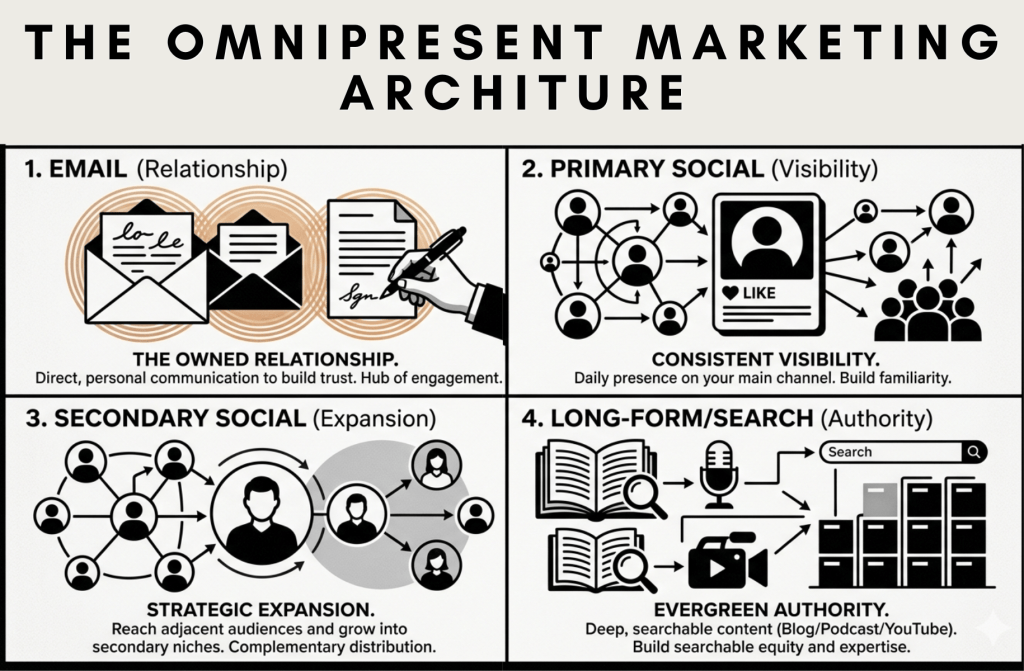
For most coaches, consultants, and service providers, the channels that matter most are these: an email list you own completely, a primary social platform where your specific audience is concentrated, a secondary social platform that expands your reach to an adjacent audience, and a long-form content channel that builds searchable, evergreen authority. Usually that is a blog, a podcast, or a YouTube channel.
That is four channels, not four hundred. And each one is there for a specific reason. Email is where you own the relationship. The primary social channel is where you stay visible and build familiarity. The secondary channel catches an adjacent audience. The long-form channel builds authority that compounds over time.
Every business we have built this structure for has found the transition manageable, even with limited team support, because the hub-and-spoke model means you are not generating original content for each channel separately. You are extending one strong piece of content into its best distribution format for each channel.
The Content Repurposing System That Makes This Sustainable
The reason most businesses fail at multi-channel marketing is not strategy. It is execution. Generating sufficient content for multiple channels while running a service business is genuinely difficult without a system behind it.
What makes it sustainable is a repurposing workflow. One long-form piece, created with intention, becomes the source material for the week across channels. The blog post becomes the email newsletter. The key points become a social series. One section becomes a short-form video script. A pull quote becomes a graphic. Done well, a single well-researched piece of content has a presence across four or five channels without requiring four or five separate creation sessions.
This is exactly the kind of content infrastructure we build for clients who want to show up everywhere without hiring a full content department. It requires a clear workflow, the right distribution tools, and someone who understands both the strategy and the execution. We have written about why consistent, educational content is itself a marketing strategy in The Education Advantage: Why Teaching Is the Most Powerful Marketing Strategy. The repurposing system is how you deliver that consistency without burning out the person responsible for it.
Building a Marketing Presence That Cannot Be Taken Away
The businesses that have real durability in their marketing are the ones that have built on owned assets. They have an email list with thousands of people who consented to hear from them. They have a blog with years of indexed content that ranks for the terms their audience searches. They have a podcast or video library that lives on their own platform and compounds in value over time.
None of that can be taken away by an algorithm change. None of it disappears if a social platform shuts down, throttles accounts, or changes its business model. The equity is theirs.
The social channels still matter. Visibility still matters. Showing up on the platforms where your audience spends time is still part of the strategy. But it is a spoke. It is not the hub. And the distinction between a business whose hub is a rented platform and one whose hub is an owned asset is the distinction between a business that survives the next disruption and one that gets restarted by it.
If you want to understand how this fits into a longer-term brand building strategy, read Legacy Brands: Building Businesses That Outlast Algorithms. The connection between platform independence and real brand longevity is not coincidental. And if your marketing is currently sitting entirely on rented land, email us at hi@legacygrowth.life or visit legacygrowth.life. We will help you build the infrastructure that protects what you have already built.






Leave a Reply