
When people ask how Legacy Growth manages to deliver the volume and quality of work we produce across more than ten active clients simultaneously, the answer is never a single tool, a single system, or a single strategy. It is a combination of all of those things, built around a team that genuinely cares about doing excellent work. And a significant part of that team is based in the Philippines.
We are not alone in this. The most efficient, high-output agencies, consulting firms, and online businesses operating today have figured out something that the mainstream business world is only beginning to catch up to: the Philippines has produced one of the most skilled, dedicated, and professional remote workforces in the world, and partnering with that talent is one of the highest-leverage decisions a growing business can make.
This is not a post about cheap labor. This is a post about exceptional people, about what makes them extraordinary partners for the kind of work that actually grows businesses, and about why the smartest founders we know are building their remote teams with the Philippines at the center.
The best team members we have ever worked with are not in a zip code. They are in a time zone that adds fuel while you sleep.
What Makes Filipino Remote Workers Different
To understand why Filipino professionals stand out in remote work environments, you have to start with the cultural and educational context they come from. The Philippines has one of the highest rates of English proficiency in Asia, with English serving as a co-official language and the primary language of business, education, and government. This means communication with Filipino team members, across email, Slack, Zoom, and project management tools, is almost always clear, precise, and professionally handled.
But language is only part of the picture. The work ethic and relational orientation that Filipino professionals bring to their roles is, in our direct experience, exceptional. There is a concept in Filipino culture called malasakit, which roughly translates to a deep, genuine care for the people and responsibilities in your life. In a professional context, this shows up as a level of investment in the quality of their work and the wellbeing of their clients that goes well beyond what a transactional professional relationship would require.
Our team members based in the Philippines do not treat their role as a job they show up for and clock out of. They treat it as a contribution they are making to something they care about. That orientation is not something you can train into someone. It is something they bring to the table from the start.
The Skill Set Is Not What People Expect

One of the persistent misconceptions about Filipino remote workers is that the talent pool is primarily limited to administrative and customer service roles. That was perhaps more accurate a decade ago. It is not accurate now.
The professionals we have hired from the Philippines for Legacy Growth are handling sophisticated work across content production, funnel building, automation programming, project management, graphic design, copywriting support, video editing, SEO, and client operations. These are not entry-level tasks. They require technical skill, creative judgment, and the ability to work independently within a system while still communicating proactively when something needs attention.
The Philippine higher education system produces a large number of graduates annually in fields including information technology, communications, marketing, and business administration. Many of the professionals entering the remote workforce have strong foundational training and then spend years developing deep expertise in their area of specialization. The result is a talent pool that is far more sophisticated than the market narrative around Filipino remote workers tends to suggest.
What Collaboration Actually Looks Like
We are a team of roughly twelve people at Legacy Growth, and the communication and collaboration across time zones is one of the things we are most intentional about. Here is what makes it work in practice.
Clear SOPs are the foundation. Every role has documented processes, not because we do not trust our team members to think for themselves, but because clear documentation removes ambiguity and allows skilled people to execute with confidence rather than constantly seeking permission or clarification. When the process is clear, the professional can focus their energy on doing the work exceptionally rather than figuring out what the work is.
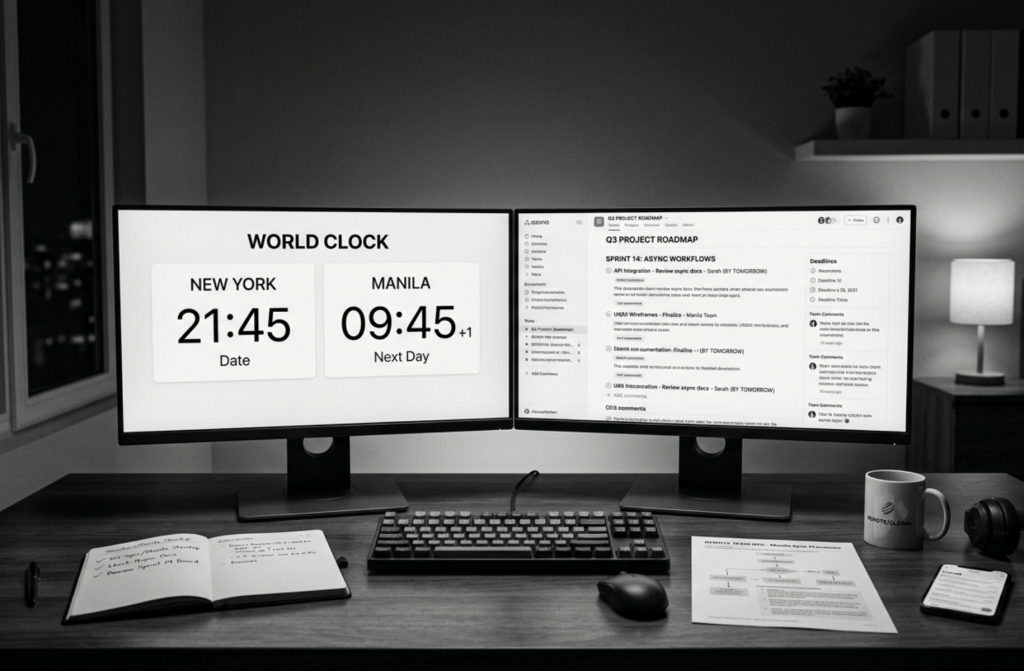
Consistent communication rhythms keep everyone aligned. We do not rely on ad hoc check-ins. We have structured touchpoints built into the week, combined with asynchronous communication tools that allow team members to flag questions, share updates, and collaborate without requiring everyone to be online at the same time.
And we treat our team members as professionals, not as contractors to be managed. This means investing in their development, communicating our goals and context clearly, and creating an environment where they feel like genuine contributors to the outcomes we are producing for clients, not invisible workers executing tasks in the background.
The Economic Reality for Both Sides

This conversation has to include an honest look at the economics, because the economic dimension is part of what makes global remote hiring both powerful and, when handled thoughtlessly, potentially exploitative.
The cost of living in the Philippines differs significantly from the United States, which means compensation that is genuinely excellent by local standards is still accessible for most growing American businesses at a fraction of what equivalent US-based talent would cost. When handled with integrity, this dynamic benefits both parties: the professional earns income that meaningfully exceeds local market rates, and the business accesses skilled talent at a cost that makes building a real team possible at an earlier stage of growth.
The key word is integrity. The businesses that build the best remote teams treat their Filipino team members as valued professionals who deserve fair compensation, genuine investment, and the same respect they would extend to any other member of their organization. The businesses that approach it purely as a cost-cutting exercise tend to get exactly what they pay for: high turnover, low investment, and the ongoing cost of constantly replacing people.
We pay our team members well by local market standards. We invest in their growth. We acknowledge their contributions publicly and privately. And the result is a team that stays, that gets better over time, and that produces work we are genuinely proud of.
Why This Matters for Your Business
If you are running a consulting business, a coaching practice, a service agency, or a brand that is trying to scale without burning yourself out doing everything manually, the question of how to build your team is one of the most important strategic decisions you will make in the next twelve months.
The entrepreneurs who are scaling efficiently right now are the ones who figured out that their job is to do the work only they can do, and to build systems and teams that handle everything else. Building a remote team, and specifically building it with the kind of talent that the Philippines produces, is one of the most reliable ways to make that transition.
You do not need to hire five people at once. You can start with one. A skilled virtual assistant or project manager who understands your business, communicates clearly, and executes reliably can free up ten to fifteen hours of your week in the first month. That time can go back into sales, into strategy, into client delivery, or into the content that builds your audience. The compounding effect over six to twelve months is significant.
Your next stage of growth is probably not a new strategy. It is the team to execute the strategy you already have.
How Legacy Growth Builds With Remote Teams
At Legacy Growth, we have built our internal team and our client delivery model around remote talent from day one. We have learned what works, what does not, and what separates the professional relationships that produce exceptional outcomes from the ones that produce frustration on both sides.
We bring this knowledge to our clients as part of how we help them scale. Whether that means helping a client think through what roles to hire for first, what a good onboarding process for a remote team member looks like, or how to build the communication infrastructure that keeps a distributed team aligned and productive, we treat the team-building dimension of growth as just as important as the marketing and content dimensions.
Because you can have the best content strategy in the world. If you do not have the team to execute it, it stays a strategy. Our job is to help you build everything you need to go from the plan to the result.
If you are ready to have a real conversation about scaling your business, whether that means building your content engine, developing your remote team infrastructure, or creating the systems that let your business grow without depending entirely on you, we are ready to have it.
Ready to Build a Brand That Works FOR You?
At Legacy Growth Consulting, we build the systems, content engines, and AI-backed strategies that scale without sacrificing what makes you human. Book your free discovery call and let’s map out exactly what your business needs to grow.
Book your free discovery call: legacygrowth.life/discover
Visit us: legacygrowth.life | legacygrowth.blog






Leave a comment